Freeform weaving
Curved ribbons, woven into smooth surfaces
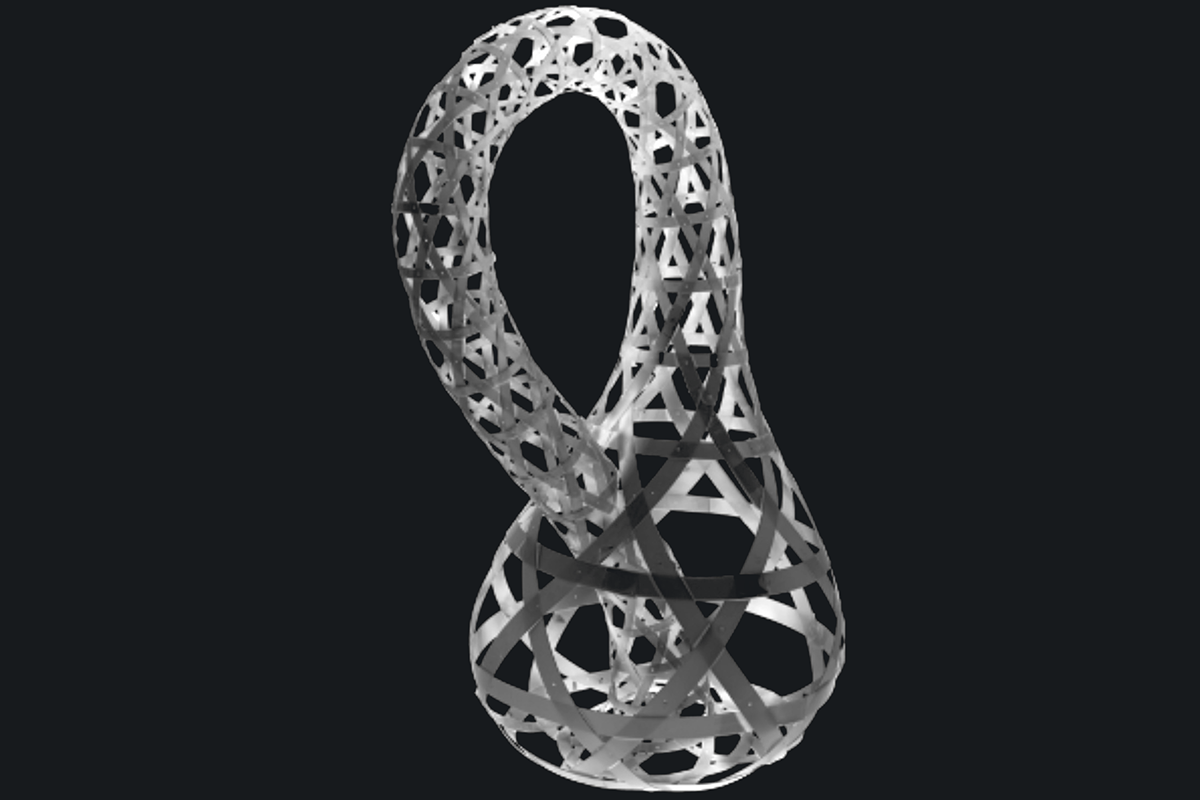
Weaving is one of the oldest things people know how to do. Long before written language, before metal, before the wheel, human hands were interlacing reeds, grasses, and split cane into baskets, traps, mats, and shelters. It is a technology that appears, independently, in nearly every culture on earth, and a language of pattern that each carried in its own direction. The coiled baskets of Indigenous North America, the plaited mats of the Pacific, the split-bamboo work of East and Southeast Asia, the date-palm vessels of the Middle East: each tradition is a deep accumulation of knowledge about how flat strips can be made to hold a curved, useful, beautiful shape. To weave is to join a very long lineage.
That lineage runs through art as much as through use. Ruth Asawa, who learned a looping technique from basket makers in Toluca, Mexico, spent a lifetime turning a single continuous line of wire into hanging forms that nest surfaces inside surfaces. Fiber and interlacing have since become a serious sculptural language in their own right, from Sheila Hicks's woven masses of color to El Anatsui's shimmering cloths stitched from flattened metal. What these artists share is an attention to the logic of the strip itself: what it wants to do, and what it can be persuaded to do.
A collaboration with a weaver
These pieces come from a collaboration with the artist and master weaver Alison Martin, working alongside the Reis and Pauly labs at EPFL. The starting point is a departure from how baskets have always been curved. Traditionally, curvature is forced into a flat weave by inserting a defect, swapping a hexagon for a pentagon, which kinks the surface and makes it faceted and abrupt. Here the curvature is coaxed in instead: by giving each ribbon a gentle, precise curve before it is woven, the surface bends smoothly and continuously, with no defects at all. The form is almost entirely geometric. Lay the ribbons out correctly and the surface finds its own equilibrium, a dome, a bird, a vessel, held together only by the friction of the crossings.
The material itself is not foraged the way reed or willow once was; it is manufactured. Each ribbon is laser-cut to an exact freeform curve computed in advance, then woven by hand. So the work sits in an unusual place: the precision of the strip is digital, but the assembly is entirely manual, slow, and physical, and it still depends on the kind of intuition that only comes from years at the loom.
The making
What does not change from the old traditions is that this takes hours, and it takes expertise. You cannot simply read the cut ribbons off a sheet and assemble them. The skill is built up gradually, by weaving progressively harder patterns until the hands learn the moves, and many of those moves are deeply counterintuitive.
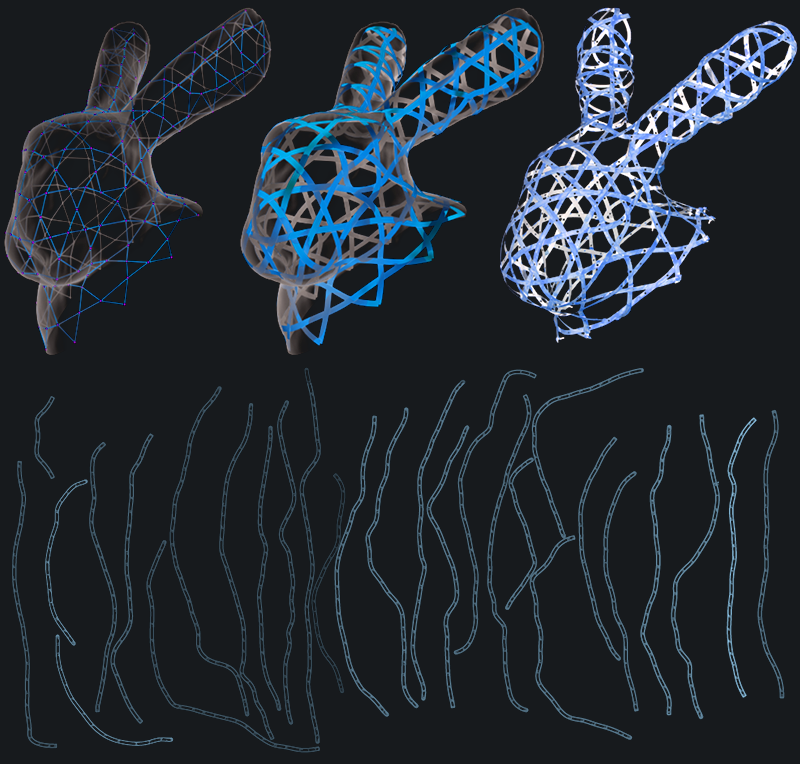
Around the bunny's ears, for instance, one wavy ribbon gets wrapped around many times over to build up the tight curvature where the surface folds back on itself. The hand wants to add more ribbons; the weave wants one ribbon, returning.
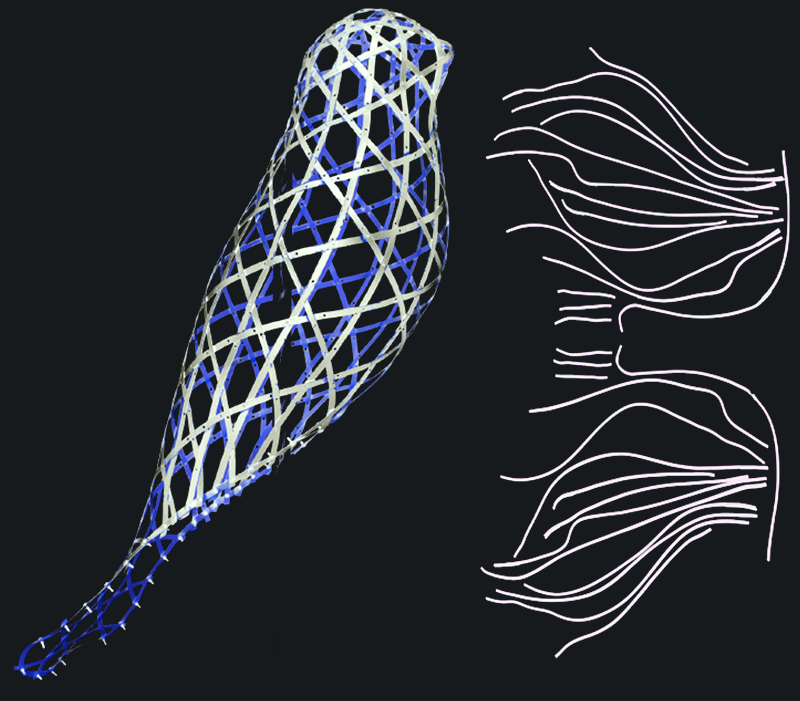
The most demanding pieces are the mathematical surfaces. On a Costa surface, the same ribbon crosses through the center of the form four times, threading the piece's three tunnels in a single continuous path before it returns to where it began. Following one strip all the way around is what separates an object that merely looks woven from one that is genuinely a single interlaced structure.
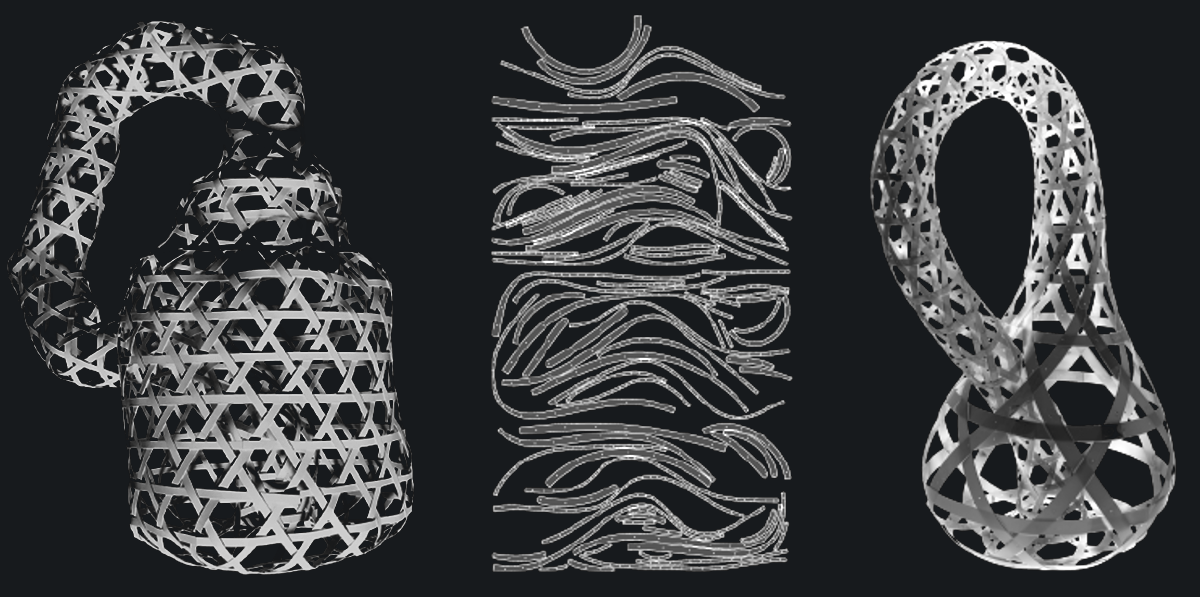
This is what the collaboration is really about. A skilled weaver can reach extraordinary forms by feel, but only so far. The computation extends that reach, specifying the exact curve of every strip in advance so that surfaces a hand could never converge on, closed loops, minimal surfaces, precise doubly-curved shells, become weavable. The craft and the algorithm meet at the laser cutter, and finish in the hands.
Notes
This is the gallery companion to the lab's research on woven structures, where the same ideas are developed quantitatively. Here the interest is in the objects themselves: how they sit, how light passes through the open lattice, and the strange smoothness of a curved surface made entirely from flat, straight-edged strips.