Weaving curved surfaces from flat ribbons
From basketry to computer-designed woven shells
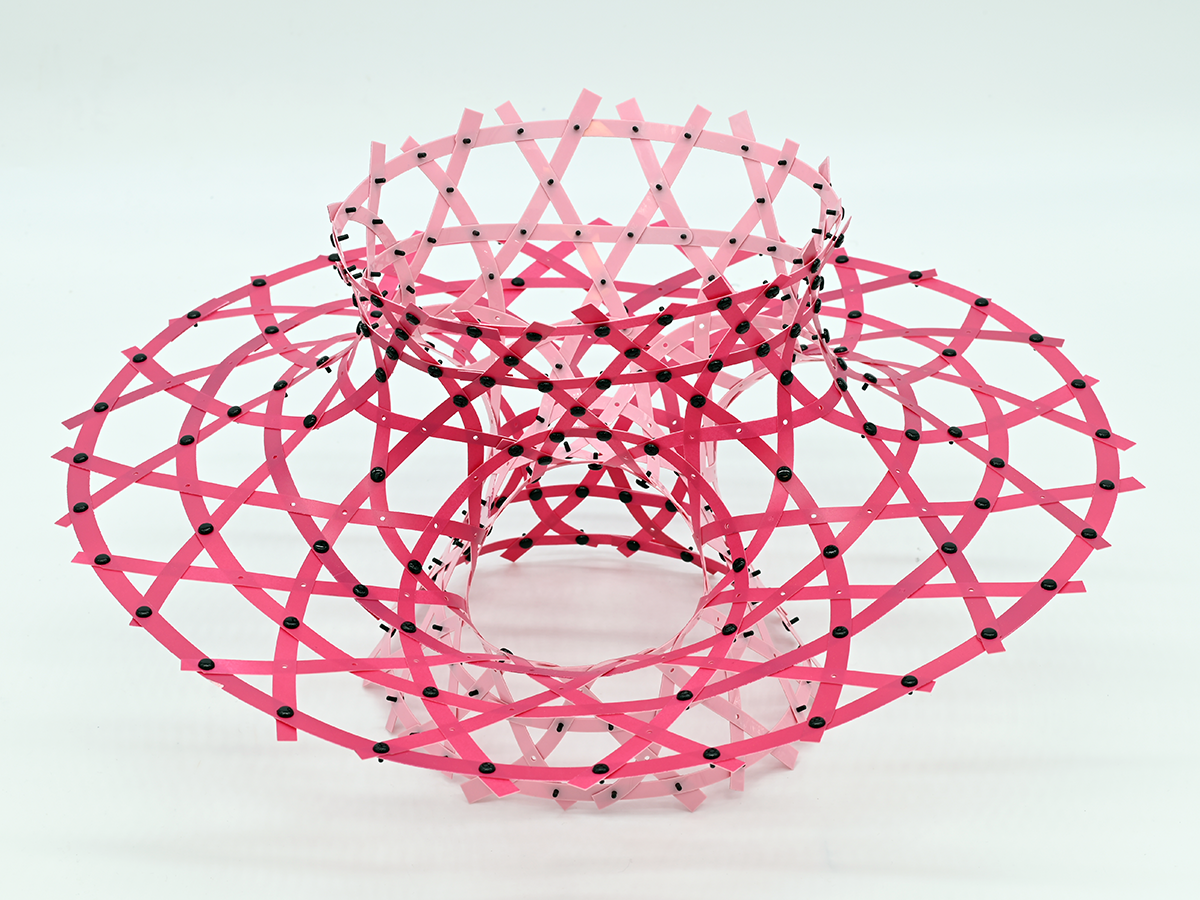
Basketry has long exploited a topological trick to generate Gaussian curvature from flat, straight strips: introducing defects into an otherwise periodic weave (substituting a pentagon for a hexagon, for instance) forces the surface out of the plane. But such defects deliver curvature only in discrete increments, leaving the accessible geometries faceted and sparse. Across three studies we pursued a more general program: weave an arbitrary smooth surface, and predict and control its mechanical response.
Programming curvature through ribbon geometry
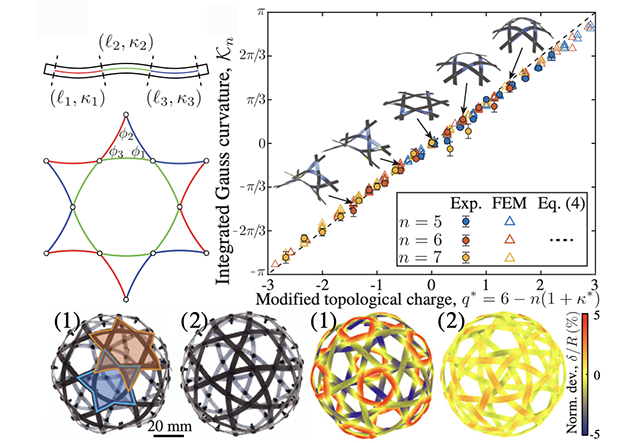
The governing observation is that the curvature of a woven shell is dictated almost entirely by the rest geometry of the ribbons, nearly independent of material properties or applied tension. Rather than straight strips, we weave ribbons with a prescribed in-plane curvature. Varying this curvature tunes the Gaussian curvature of the assembled weave continuously, replacing the discrete jumps of defect-based weaving. Through rapid prototyping, X-ray micro-CT, and simulation we established that this is essentially a geometric phenomenon.
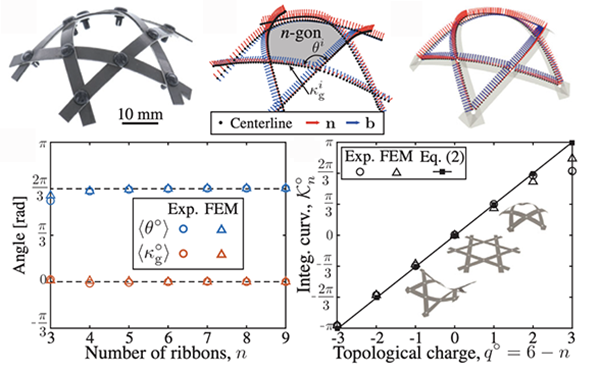
This geometric reasoning, rooted in the Gauss-Bonnet theorem, predicts the integrated Gaussian curvature of a weave directly from its ribbon curvatures and topology, and we used it to realize smooth spheres, ellipsoids, and tori.
Inverse design of the ribbon shapes
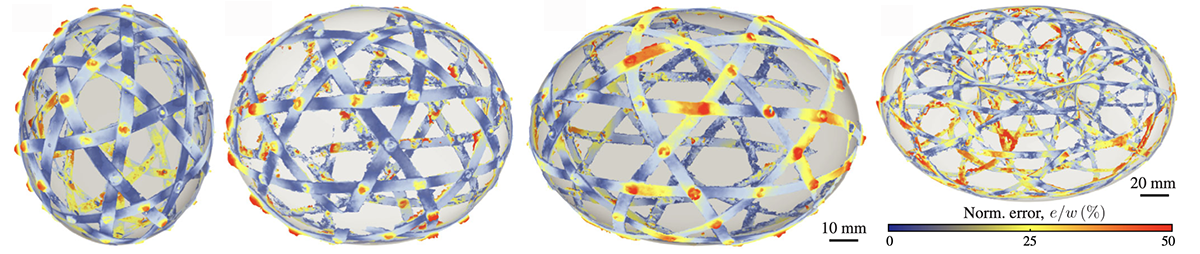
Once geometry is identified as the controlling variable, the design problem inverts: given a target surface, what is the rest shape of each ribbon? Because a globally interlaced weave is statically coupled, with every ribbon constraining its neighbors, the forward map is intractable analytically. We developed a computational inverse-design pipeline that takes a prescribed 3D surface together with a weave topology and solves, through a multi-stage solver, for the planar freeform geometry of each ribbon such that the woven assembly relaxes to the target at mechanical equilibrium. The flat ribbons can then be laser-cut and woven by hand.
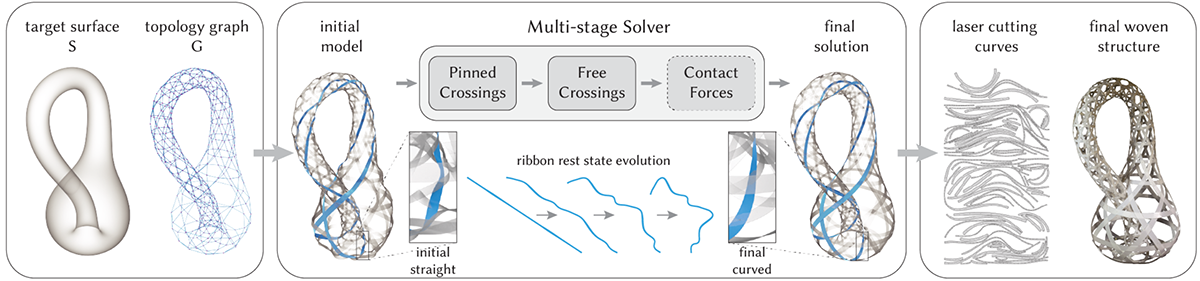
This admits free-form surfaces inaccessible to conventional weaving, each validated against fabricated prototypes.
Mechanics of woven shells
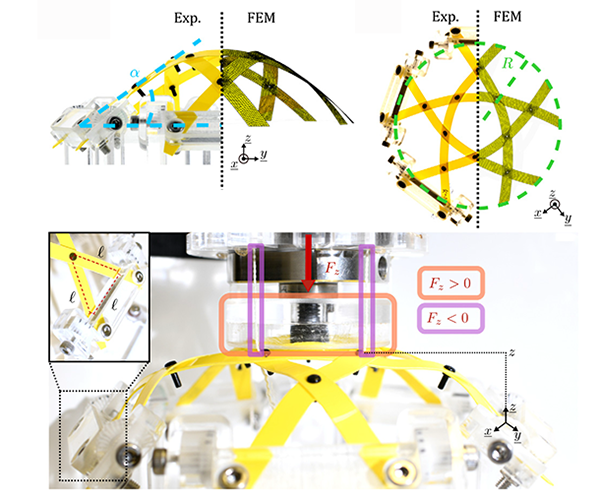
Geometry is only half the problem. We also characterized the mechanical response of these woven domes under indentation. The behavior is strongly nonlinear: the shell stiffens, then undergoes snap-through instability and inverts, in some regimes settling into a second equilibrium.
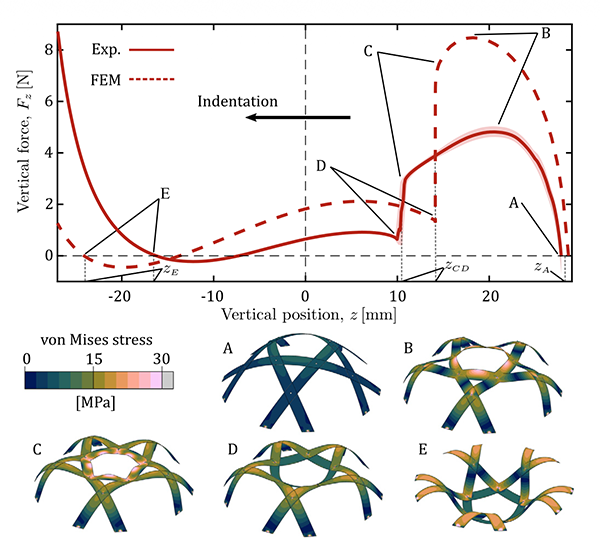
Notably, the same parameters that set the shape, namely the ribbons' in-plane curvature and the boundary conditions at their clamped ends, also govern this response, allowing a dome to be tuned from monostable to bistable. A reduced beam-bending model predicts the onset of this transition.
Significance
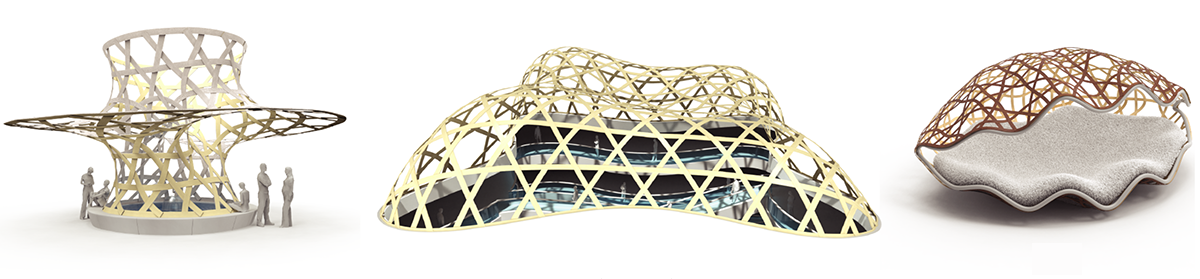
Collectively these results convert an empirical craft into a predictive design framework: specify a smooth surface, compute the planar ribbons that weave into it, and program the snapping and bistability of the result. Since the structures self-assemble from inexpensive flat strips into stiff doubly curved shells, the approach suggests applications in deployable architecture, lightweight structures, and reconfigurable surfaces.
The work appears in Physical Review Letters, ACM Transactions on Graphics (SIGGRAPH), and Extreme Mechanics Letters.
A collaboration with Pedro Reis's Flexible Structures Lab and Mark Pauly's Geometric Computing Lab at EPFL, and weaver Alison Martin.