Programmable active lattices
2017–2019
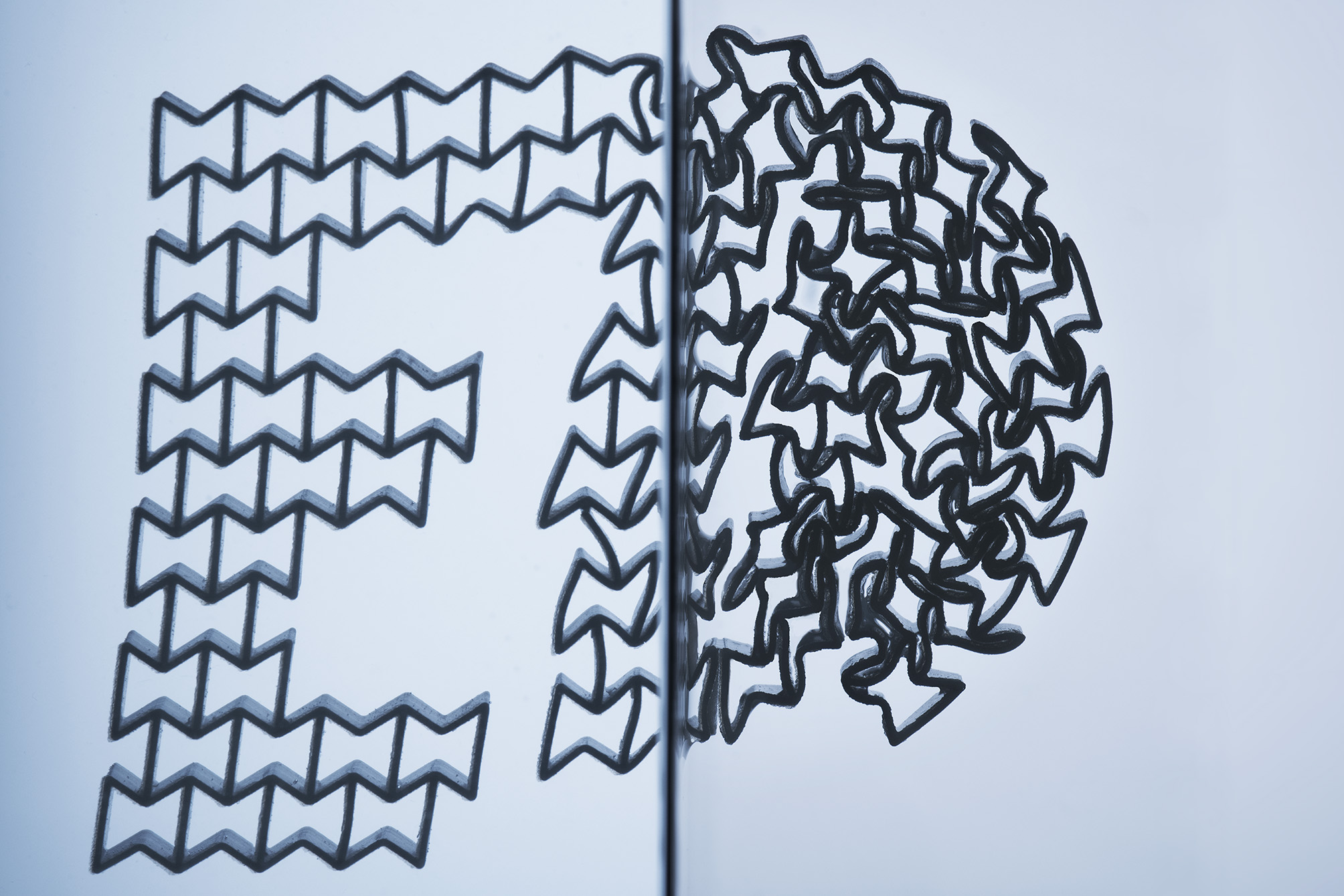
A cellular solid's mechanics are usually fixed at fabrication: a lattice is stiff or compliant, rarely both. Across two studies we use 4D printing of shape-memory polymers to let one printed lattice reprogram its own mechanics after manufacture. An active joint changes the unit cell's connectivity on demand, moving it across Maxwell's threshold between a stiff stretch-dominated and a compliant, dissipative bending-dominated lattice. The same strategy drives large shape change: auxetic sheets program area changes up to about 200 percent and morph from a flat precursor into a prescribed form on heating. Encoding reconfiguration in geometry and material rather than motors points toward structures that adapt over a mission.
References
- Wagner M, Chen T, Shea K. Large shape transforming 4D auxetic structures. 3D Printing and Additive Manufacturing 4(3), 133–142 (2017).
- Wagner MA, Lumpe TS, Chen T, Shea K. Programmable, active lattice structures: unifying stretch-dominated and bending-dominated topologies. Extreme Mechanics Letters 29, 100461 (2019).