Deployable surfaces, from the benchtop to the wafer
2021–2026
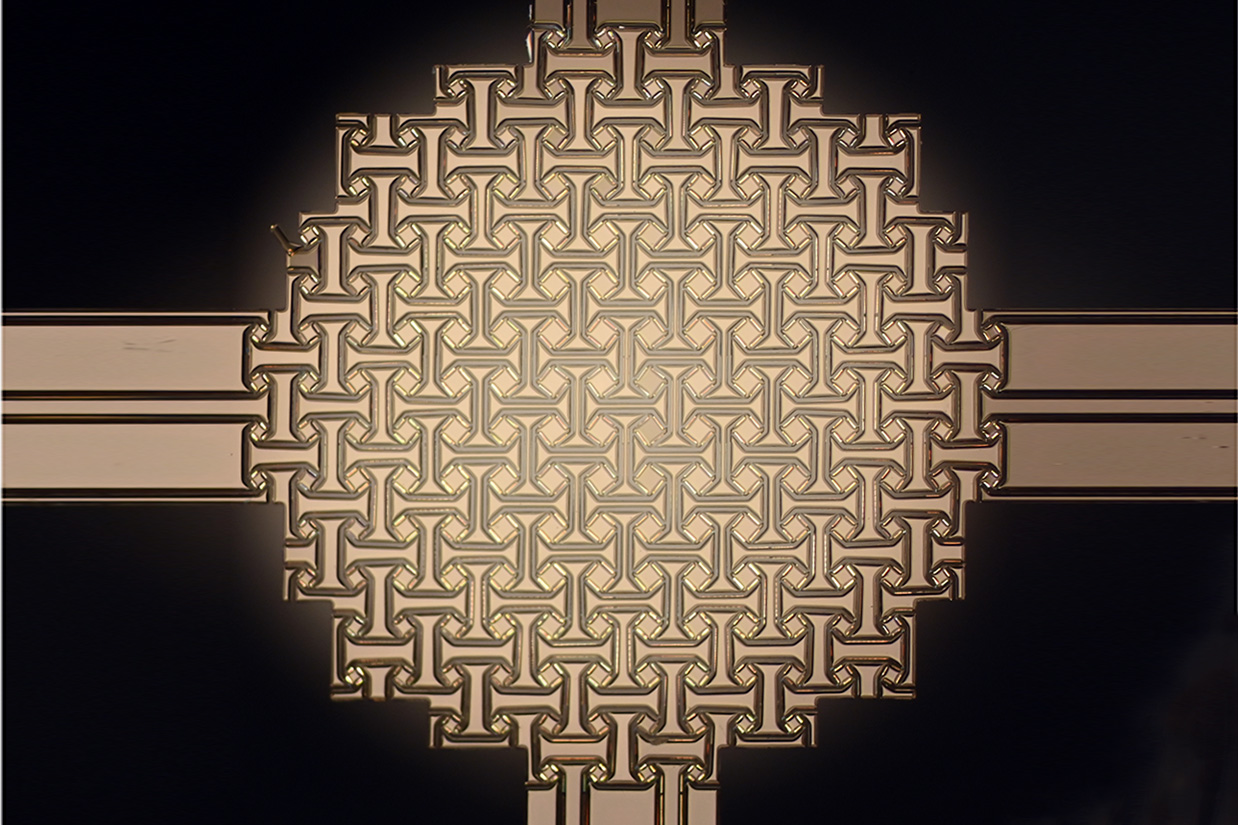
Can a flat sheet be programmed to deploy into a prescribed, self-supporting 3D surface with no mold, frame, or power, and how far down in scale does it survive? We tile a sheet with bistable auxetic cells that expand under tension and latch in a second stable state, so a spatially varying expansion makes the sheet buckle into a determined shape and hold it. A conformal flattening of the target, matched cell by cell against a precomputed library, yields the flat pattern. Carried to the micron scale, standard wafer photolithography produces free-standing polyimide shells, including a dome and gold-coated paraboloidal reflectors whose optics match prediction, extending flexible electronics toward deployable antennas, sensors, and micro-optics.
References
- Chen T, Panetta J, Schnaubelt M, Pauly M. Bistable auxetic surface structures. ACM Transactions on Graphics 40(4), 1–9 (2021). SIGGRAPH.
- Wang Y, Shum K, Song Y, Chen T. Deployable 3D architectures from wafer-fabricated precursors. Nature Communications (2026).