A solar array that deploys itself
Elastic flasher origami and scissor rings, triggered by warmth alone
Deployable structures are used where access is difficult: in orbit, in space, and in disaster zones. The conventional approach separates the system into a passive folded payload and a network of motors and controllers that deploys it. Each added actuator adds mass, wiring, and failure modes. This project takes a different approach: the actuation is built into the material, so that the structure senses its environment and deploys without external control. The demonstration is a solar-panel array that expands its area tenfold, from roughly 0.05 to 0.5 square metres, in under 40 seconds, triggered by a rise in ambient temperature alone.
One cell, two mechanisms
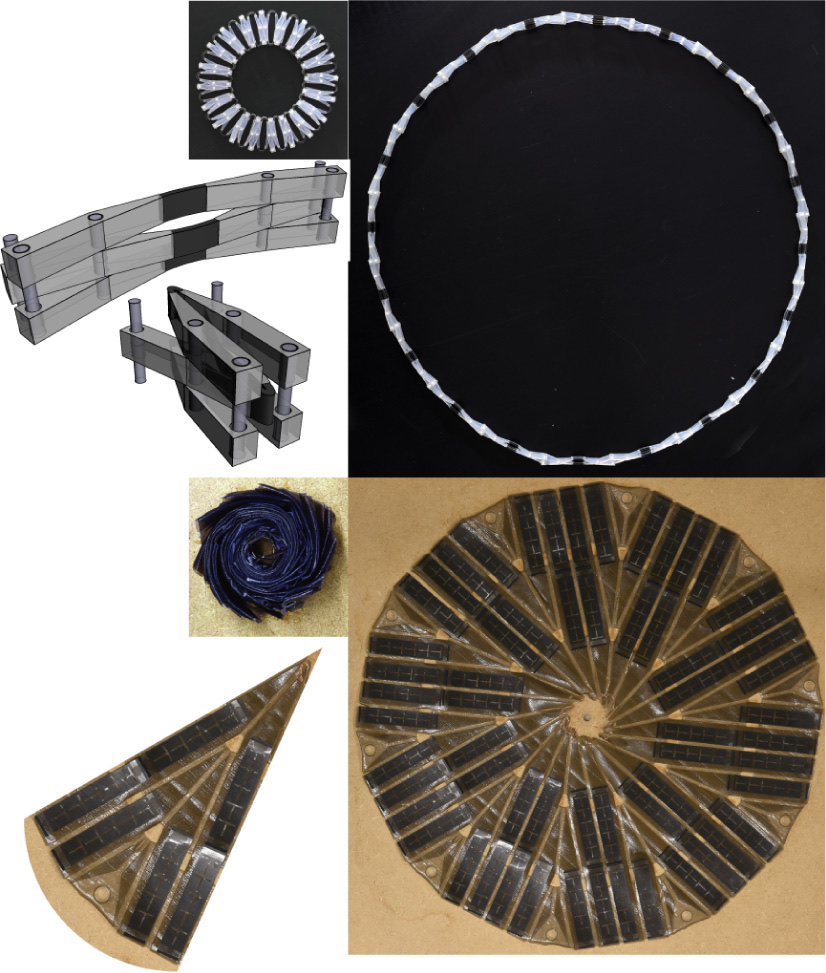
The array is a functional metamaterial with rotational periodicity: a ring of identical wedge-shaped unit cells, each combining one arm of an elastic "flasher" origami with a pair of scissor mechanisms. The scissors form the outer ring - a single-degree-of-freedom mechanism similar to the Hoberman sphere - which serves as both the primary structure and the primary actuator; its radius increases from 125 to 395 millimetres as it opens. The origami forms the inner substrate that carries the flexible solar panels and folds entirely inside the void of the collapsed ring. Kinematic analysis of the real, finite-thickness parts - not just the idealized mechanism - sets the expansion ratio, and the crease pattern's two free parameters were optimized so the folded substrate carries the largest possible number of panels.
Folding dynamics
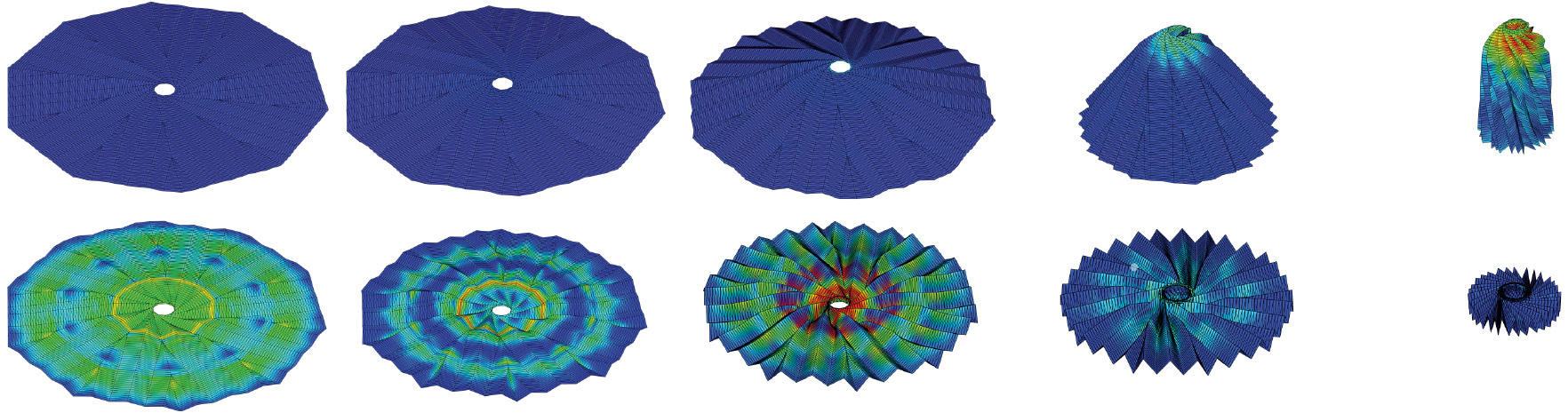
Collapsing the flasher origami is the more difficult half of the problem. Simulating the folding dynamics revealed a bifurcation: depending on how fast the pattern is folded, it collapses into either a flat disk or a cone, and only the disk fits the stowed configuration. Mapping the energy landscape of the two paths led to a rotational core apparatus that guides the fold reliably into the disk state. Deployment proceeds in two stages - the array first rotates, unwinding its spiral, and then expands radially - and the printed system follows the simulated sequence closely in both configurations.
Deployment by warmth
The autonomy comes from the material. The hubs of every scissor and the entire origami substrate are 3D-printed in a shape-memory polymer: glassy and stiff below its transition temperature, orders of magnitude softer above it. Collapsing the array while warm programs a prestrain that is locked in on cooling, so the stowed structure is rigid and holds its shape without restraint. When the ambient temperature rises above the transition again, the stiffness drops, the stored strain is released, and the array unfolds. A viscoelastic model of the printed polymer, calibrated by thermal analysis and validated in a temperature-controlled load frame, predicts the whole self-expanding sequence. Because sensing, actuation, and structure are provided by the same material, the system requires no wiring, control electronics, or separate actuators.
Related publications
- Autonomous deployment of a solar panel using elastic origami and distributed shape-memory-polymer actuators. Physical Review Applied 11(6), 064069 (2019). Editors' Suggestion; Featured in Physics. PDF
Press
- 2019.07 TechCrunch This solar array expands itself at the right temperature
- 2019.06 Physics Magazine Focus: Folded Solar Panel Opens Without Power Source