Knit mechanics, from yarn to garment
A multi-level modeling and design framework for weft-knitted fabrics
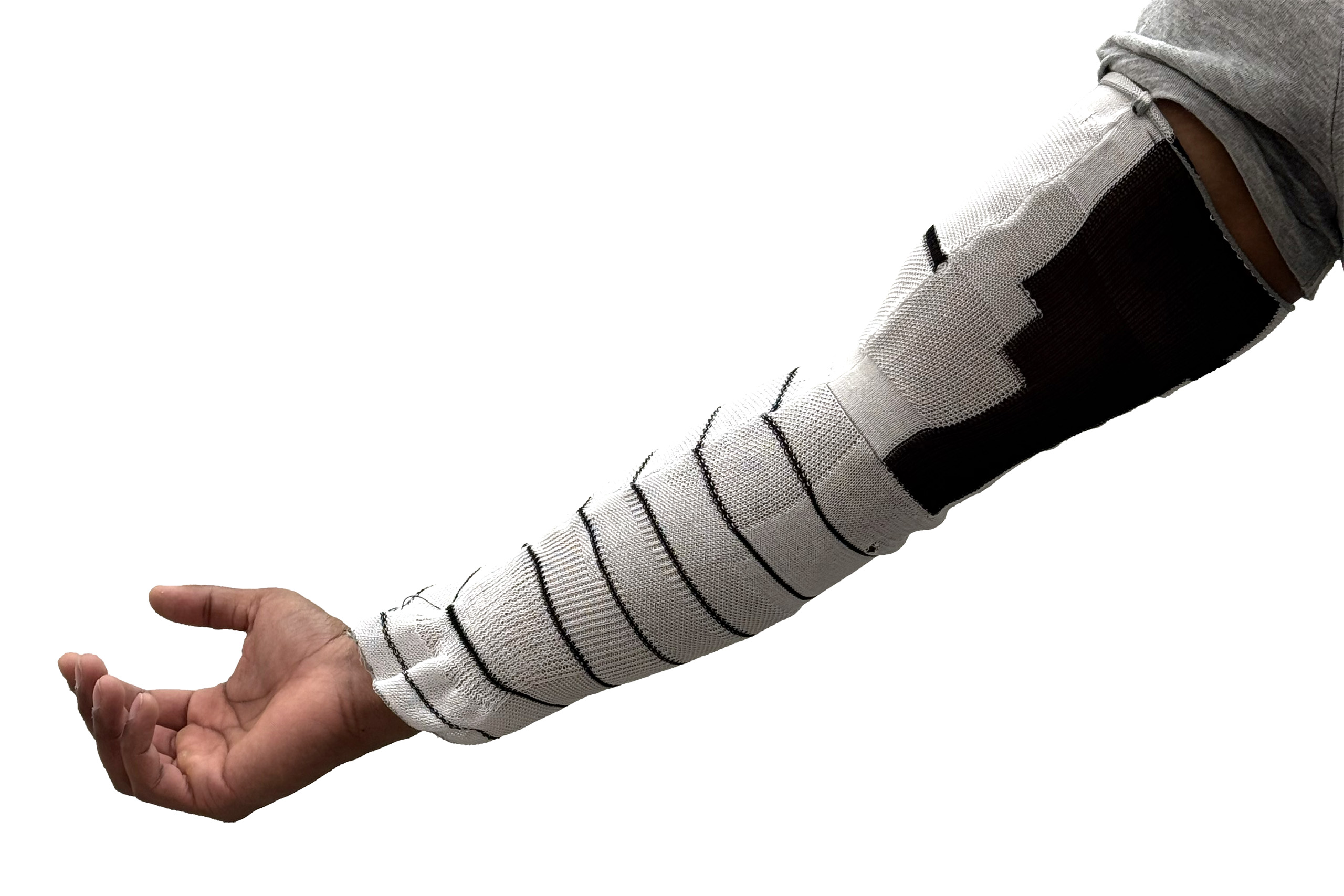
A weft knit is a single yarn looped into a fabric. Its stretch, recovery, and handle are determined by how those loops slide, bend, and jam against each other. This microstructure makes knits well suited to wearables and soft robotics, and it also makes them difficult to predict: the response is nonlinear, anisotropic, and history-dependent, so industrial knit design still relies on swatch-by-swatch testing. This project, led by our collaborators at Stanford with MIT and AIM, replaces that testing with a modelling framework that retains yarn-level fidelity and is fast enough to use for design.
From yarn to fabric
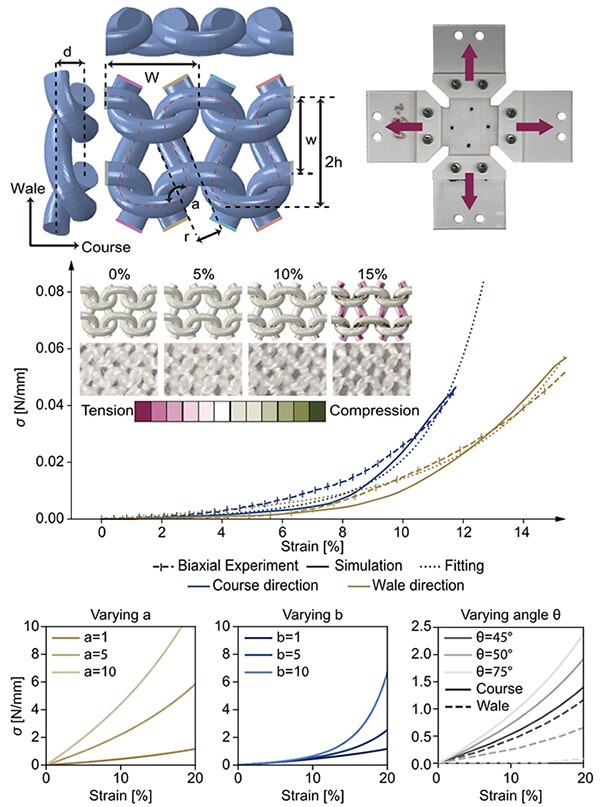
The framework starts at the yarn: we measure the axial and transverse response of three industrial yarns - plied cotton, textured nylon, and a PET monofilament - and model them as anisotropic materials rather than as idealized elastic rods. Each stitch is then resolved as a solid curved rod in a volumetric finite element model, with contact, friction, and the pre-tension that knitting itself introduces. Against biaxial experiments across stitch lengths, patterns, and yarn materials, the simulations agree with measurement to within a few percent, and, once validated, they predict new fabrics without per-fabric recalibration.
Three numbers per fabric
A volumetric simulation takes tens of hours per fabric. The framework therefore homogenizes each simulated knit into a strain-energy surrogate with three physically meaningful parameters: initial stiffness, stiffness growth, and the direction of anisotropy. The surrogate is built on the Holzapfel-Gasser-Ogden form already available in commercial finite element tools, so a validated fabric becomes a material definition usable in standard finite element software, and a fabric-level prediction takes minutes instead of hours.
Fabrics as patchworks
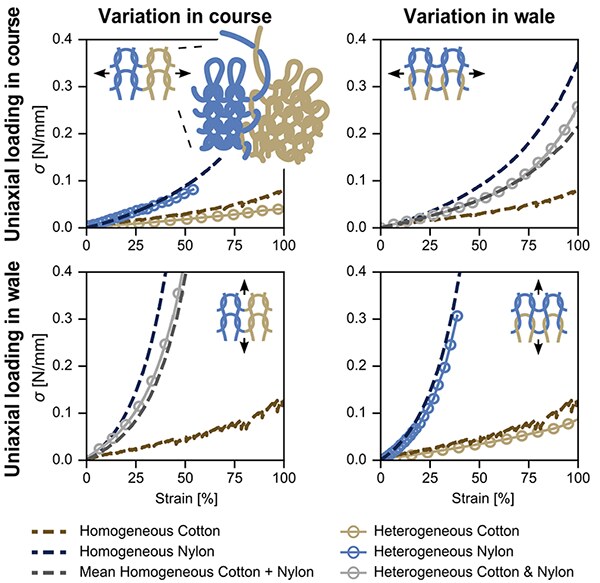
Real garments are not homogeneous: yarns and patterns change from region to region. Testing knits with deliberate material transitions showed that the interfaces contribute little of their own - a heterogeneous fabric behaves like its homogeneous regions joined as springs in series or parallel, depending on whether the load runs along or across the transition. This result makes design tractable: a garment can be treated as a patchwork of validated regions without loss of predictive accuracy.
A sleeve with uniform pressure
The demonstration is a compression sleeve. Skin-tight garments stretch differently at the wrist, the forearm, and the bicep, so a uniform fabric applies uneven pressure; commercial sleeves compensate with seams and panels. We reconstructed a volunteer's arm in 3D, mapped it to the knitting machine's cylindrical coordinates, and used the framework to select the stitch length, pattern, and yarn for each region so that the worn stress is constant along the arm. The sleeve is knitted as a single piece on an industrial machine from an algorithmically generated pattern, and force sensors along the arm confirm that the pressure remains uniform, before and after 45 minutes of exercise.
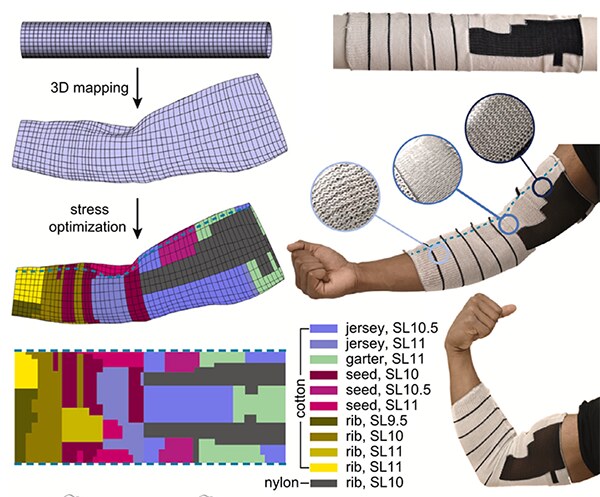
The same procedure - measure the yarn once, simulate the fabric, optimize the patchwork - extends to bodysuits, medical compression garments, and the knitted skins of soft robots: garments engineered to a specification rather than fitted by iteration.
Related publications
- Multi-level mechanical modeling and computational design framework for weft knitted fabrics. Extreme Mechanics Letters 82, 102423 (2026). PDF