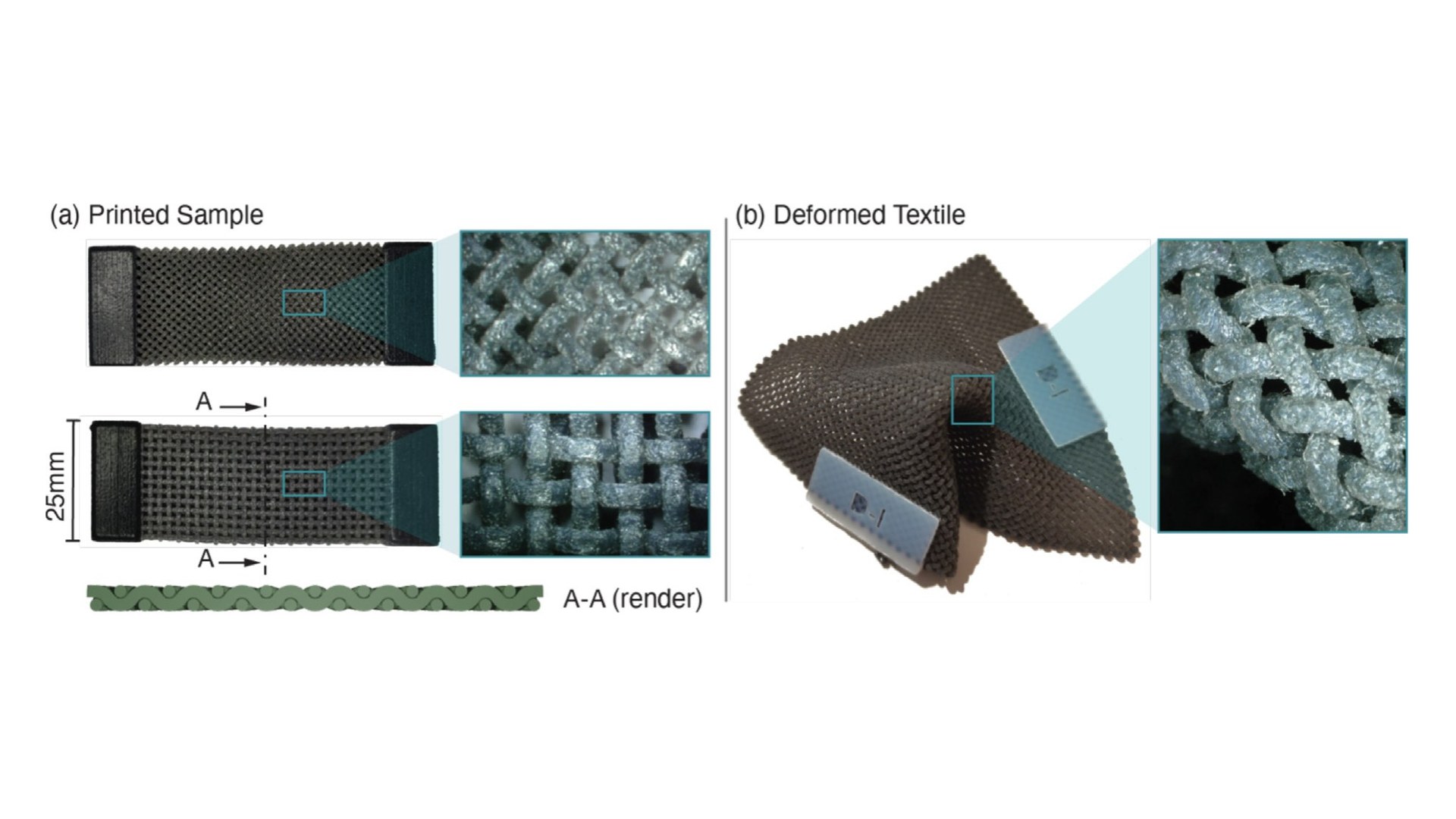
3D-printed biaxial weaves
Biaxial weaves, two orthogonal sets of interlaced yarns, were generated from an eight-parameter model, printed by material jetting in a flexible digital material, and tested in tension. A two-stage design of experiments, a definitive screening design over 44 runs and then a full factorial design over 48, maps the design parameters to a bilinear stress-strain model with a transition strain and a major modulus. The weave angle sets the deformation mode: yarn stretching along the yarns, shear followed by interlocking on the diagonal. Yarn diameter, pattern length, and yarn spacing set the slopes. Yarns tear across the print layers rather than delaminating, so the printed textile behaves as a quasi-continuous structure regardless of its in-plane orientation.
Reference
- Wirth M, Shea K, Chen T. 3D-printing textiles: multi-stage mechanical characterization of additively manufactured biaxial weaves. Materials & Design 225, 111449 (2023).