3D-printed knits
Programmable materials built from a single entangled thread
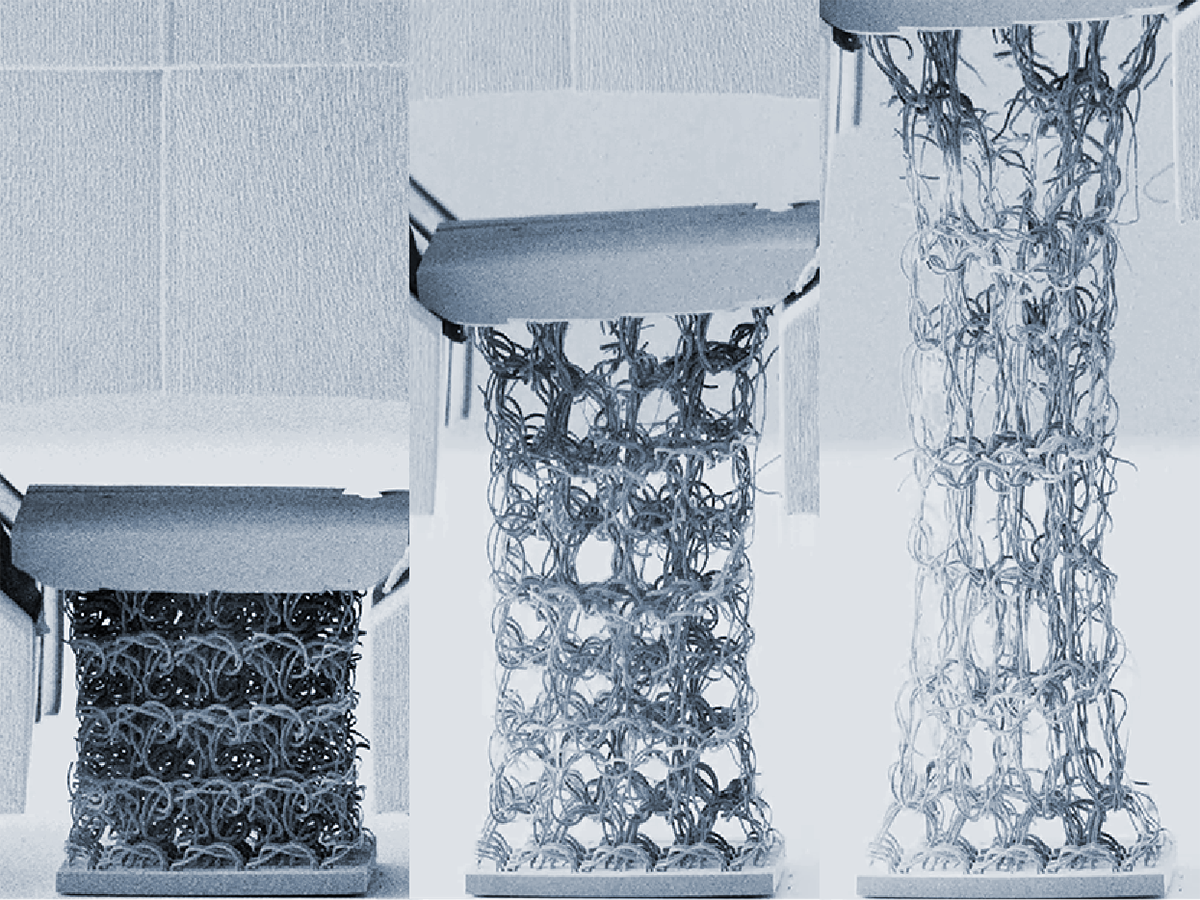
A knitted fabric is a single continuous yarn interlooped through itself thousands of times. That topology of entanglement, rather than the intrinsic properties of the fiber, dominates the macroscopic mechanics: stretch, recovery, and toughness emerge from how the loops engage and slide against one another under load. Despite millennia of practice, the design space has remained largely empirical, because conventional knitting machines can only realize the loop geometries their needle beds permit, leaving stitch structure and mechanical response coupled in ways that resist systematic study.
We decouple them by 3D-printing the knit. Deposition is not constrained by needle kinematics, so we can fabricate any loop geometry expressible as a curve, isolate exactly how stitch architecture governs the response, and extend knitting into forms a needle bed cannot make.
Printing a fabric
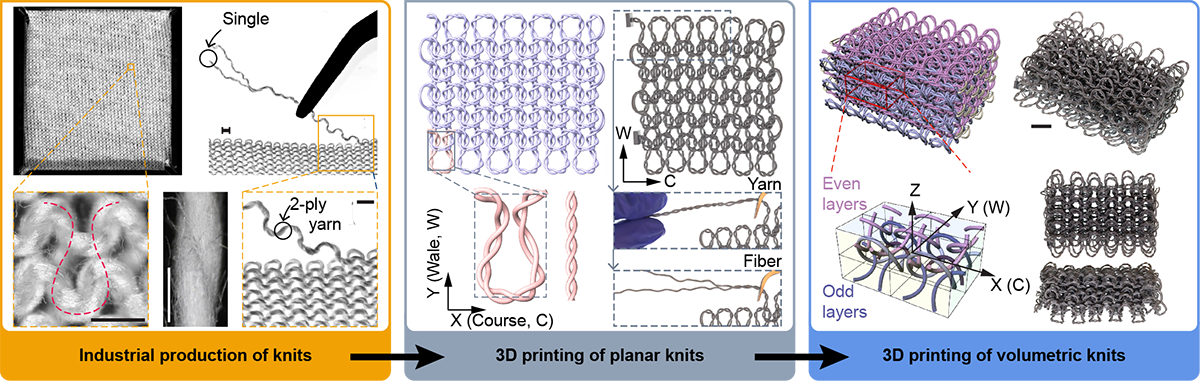
We parameterize the yarn path as an analytic space curve, one loop of the stitch, and wrap helical fibers around it to build a structured, hierarchical thread. A multi-material inkjet printer jets and UV-cures photopolymer droplets against a water-soluble support, yielding a compliant fabric whose loops can be unraveled like a conventional knit. A small set of geometric parameters (loop height, width, depth, curl, and fiber count and thickness) spans a continuous family of fabrics, each fabricated and mechanically characterized.
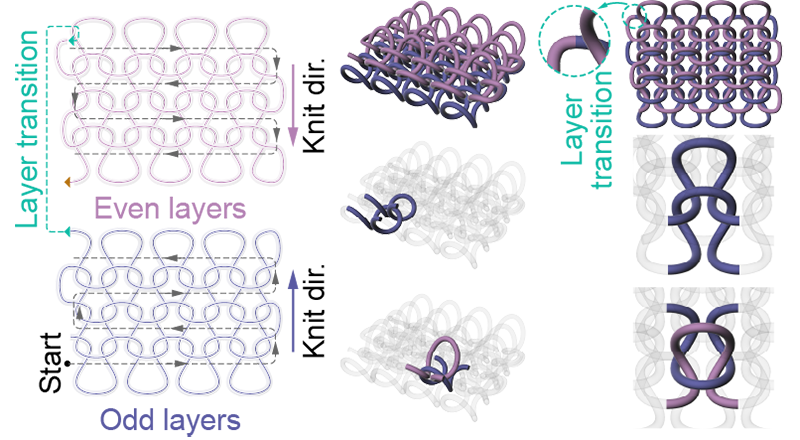
Because the geometry is defined mathematically, the same description extends from a flat fabric to a fully three-dimensional one. A volumetric knit is built from a single continuous centerline that loops in-plane on each layer and then transitions through the thickness, interlocking neighboring layers so the whole block is one entangled thread.
Printed knits reproduce textile mechanics
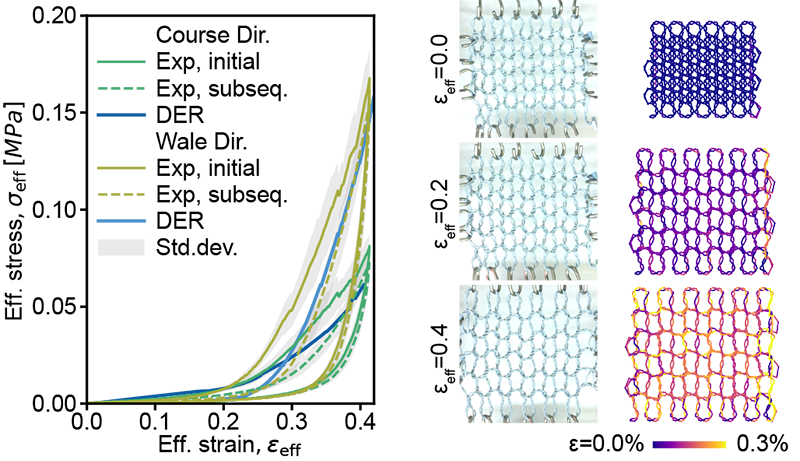
Under cyclic biaxial loading, the printed fabrics show the signatures of true textiles: pronounced mechanical anisotropy between the course and wale directions, strain-stiffening as the loops draw taut, and hysteresis from interloop friction, with the loading and unloading branches not coinciding. A discrete-elastic-rod (DER) simulation that models each loop and its frictional contacts reproduces the measured curves and exposes the underlying yarn-level deformation.
A single master curve
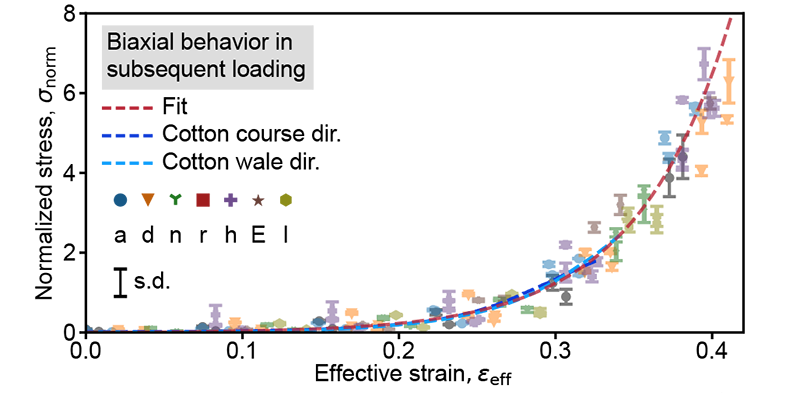
The central result is a collapse. Rescaling the stress-strain curves across materials and loop geometries by one combination of the geometric parameters maps them onto a single master curve, which also captures an industrial cotton knit. The characteristic nonlinear, dissipative response of a knit is therefore set by its geometry and entanglement and is largely material-independent, giving a predictive relation for a fabric's behavior before it is ever fabricated.
Programmable behavior
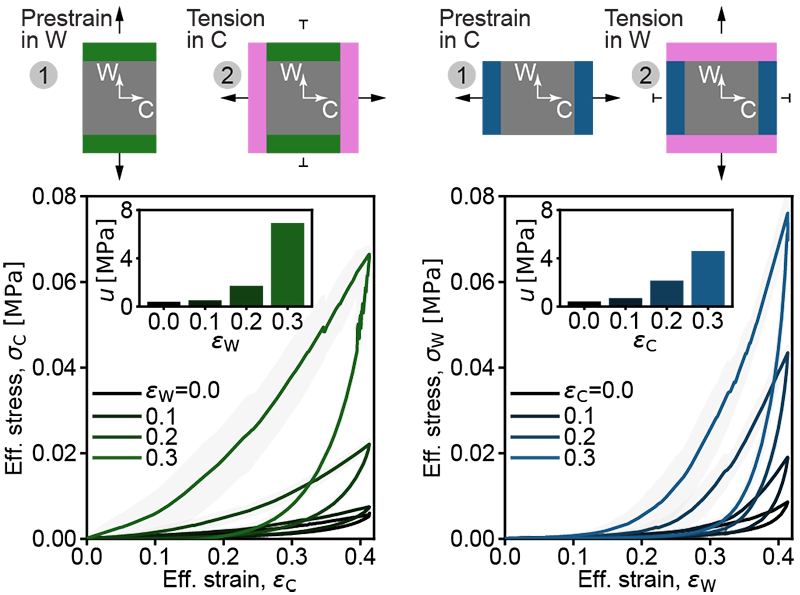
Because the fabric is a single connected thread, loading along one axis changes how it responds along the other. Exploiting this coupling, we pre-strain a knit in one direction to tune the stiffness and the energy it dissipates in the orthogonal direction, configuring one object as either a compliant spring or an adjustable damper without changing its architecture.
Into three dimensions
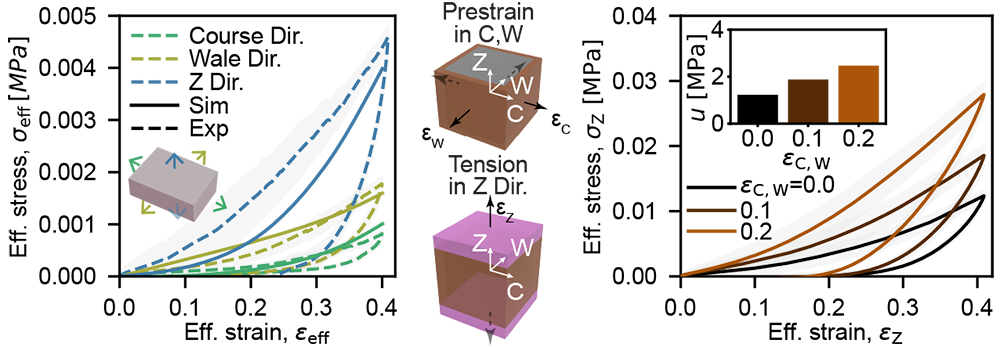
The volumetric knit carries these ideas into the bulk. Loaded along its three principal axes it is strongly anisotropic, and the same single-thread coupling lets us program its through-thickness (Z) response by applying a biaxial pre-strain in the plane, so a solid block of knit becomes a tunable, dissipative element.
The same knit, at the micron scale
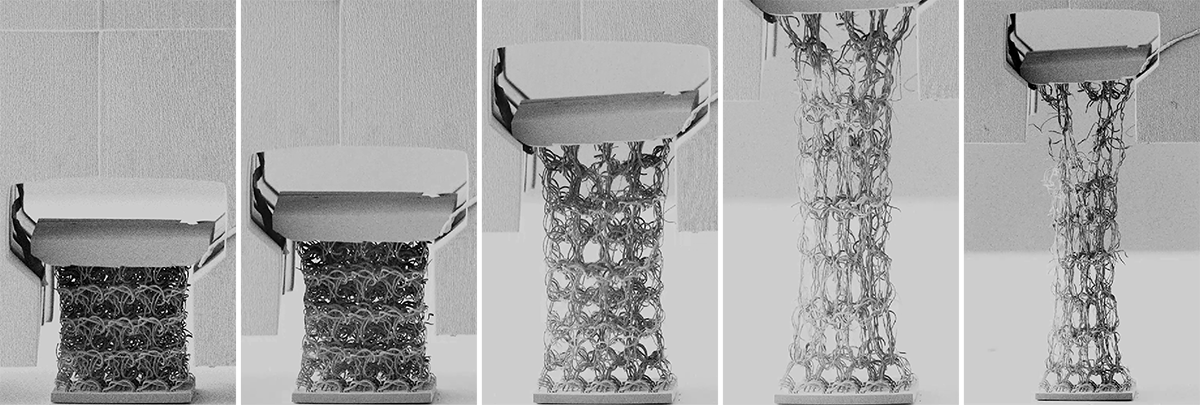
To test whether the architecture is truly scale-invariant, we reproduced the identical volumetric knit at micrometer resolution using two-photon laser nanoprinting and pulled it to rupture in situ. To our knowledge it is the smallest knit yet fabricated, and once stresses are normalized by the base material it follows the same deformation sequence and reaches a similar ultimate strength as its macroscale analog, confirming that the governing mechanism is geometric rather than material.
Why it matters
This recasts knitting as a general design principle for architected materials: prescribing the entanglement prescribes resilience, toughness, and tunable energy absorption directly in an object's structure. Because the behavior collapses onto a predictable master curve and can be programmed by pre-strain, the same approach spans reusable impact protection and adjustable damping at the human scale and, at the micron scale, points toward tissue scaffolds, filtration media, and multifunctional composites.
Supported by NASA MIRO (IDEAS², grant 80NSSC24M0178), the Haythornthwaite Foundation, and the National Science Foundation (CMMI-2418432).
Related publications
- Entanglement-driven responses through multiscale 3D-printed knits. Proceedings of the National Academy of Sciences, 123(22), e2535708123. (2026). PDF