A reprogrammable metamaterial with memory
A material you can rewrite like a hard drive
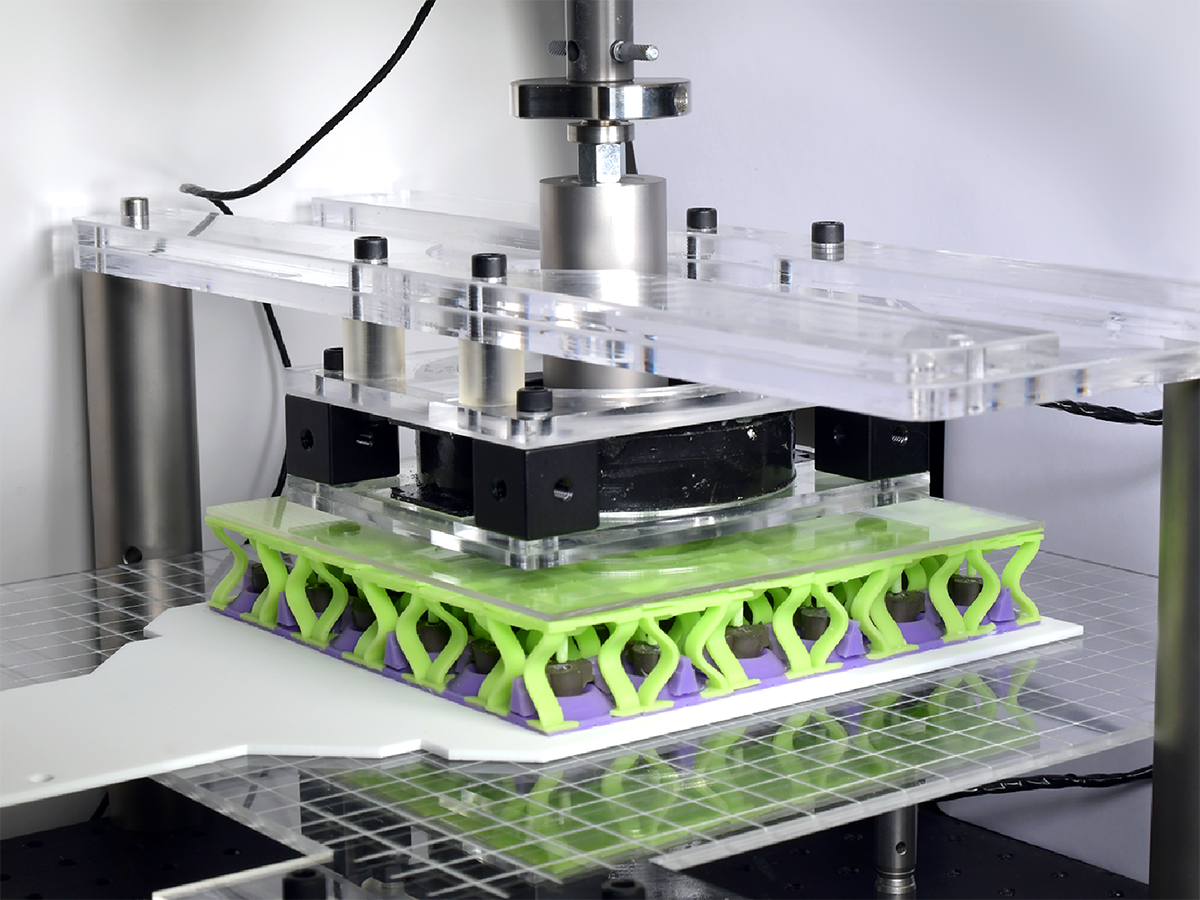
A metamaterial derives its properties from its architecture rather than its constituents, but those properties are typically fixed at fabrication and cannot be altered afterward. We asked whether a material could instead be rewritten like a hard drive: each element set independently to one of two states, on demand and repeatedly, while retaining that setting without any sustained energy input.
A mechanical bit
The building block is an m-bit, the mechanical analogue of a digital bit. It supports the same three operations as nonvolatile memory:
- Write: a magnetic pulse switches the m-bit by snapping an embedded bistable shell through to its other equilibrium configuration.
- Memory: the new state persists indefinitely with no applied field, since both configurations are local minima of the elastic energy.
- Read: mechanical loading probes the state through its stiffness, and the read operation is nondestructive: it does not perturb the stored value.
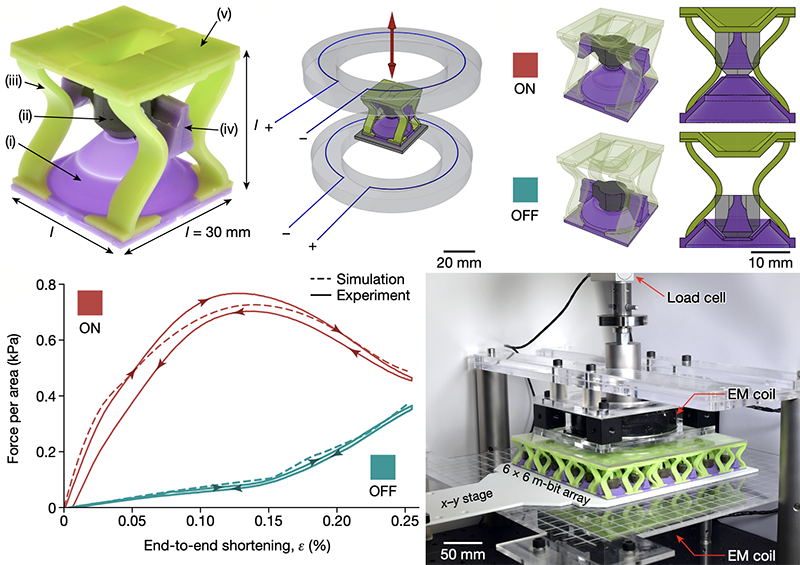
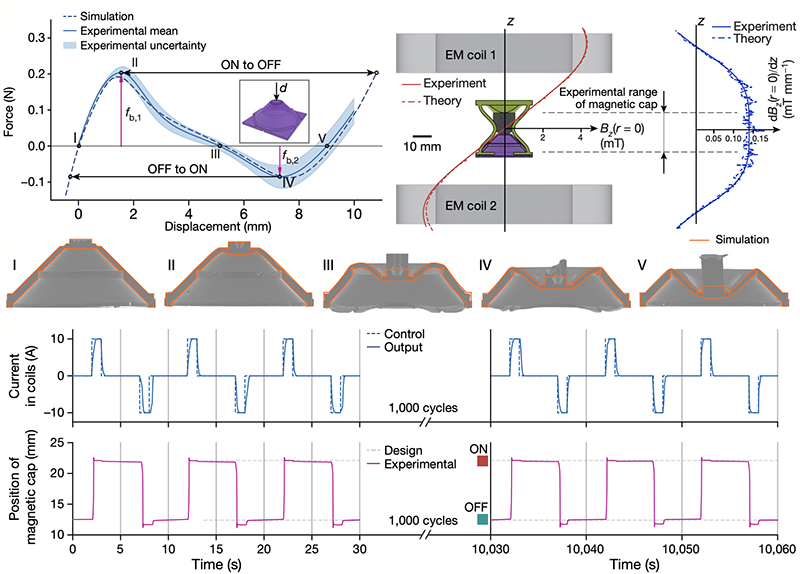
Writing is magnetic. A small permanent magnet on the bistable shell is driven through its snap by a pair of electromagnetic coils, and the state then holds with no field. The switch is robust: a single m-bit was cycled over a thousand times while returning reliably to the same two equilibria.
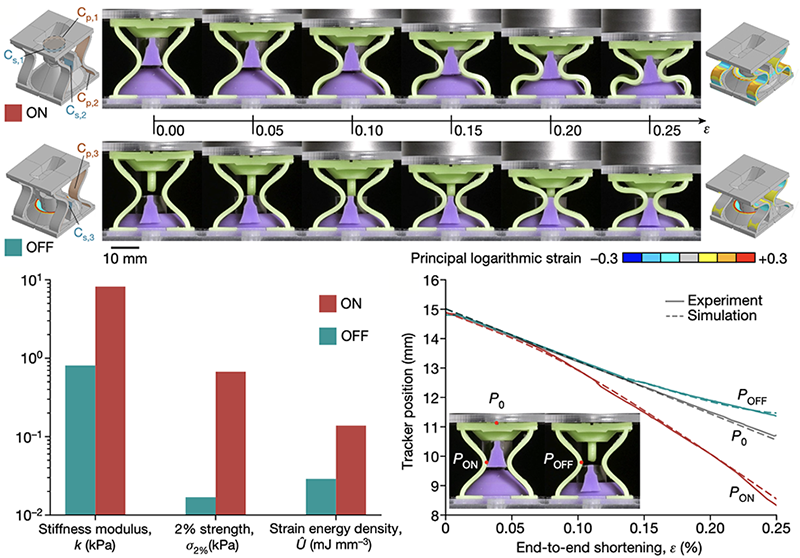
The two states have markedly different mechanical responses. In the ON state, load is transmitted axially through internal contacts, giving a stiff, strong element. In the OFF state, slender curved members deform in bending, giving a compliant one. Switching between states changes the stiffness, strength, and stored energy each by roughly an order of magnitude, and the response remains elastic throughout, so the cycle is fully reversible.
Programming a whole material
Each m-bit occupies a cubic unit cell and tiles into a periodic array. We built a 6 × 6 lattice and programmed it with a single actuator: a pair of electromagnetic coils registers to each target cell and switches it alone, leaving its neighbors untouched. This realizes bit-level random access, the defining feature of addressable memory.
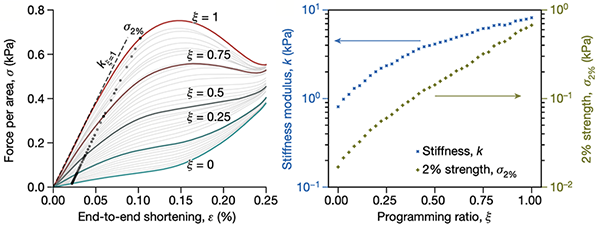
Choosing the binary pattern of ON and OFF cells sets the bulk response of the identical physical lattice. As the fraction of ON cells (the programming ratio) increases, the effective stiffness and strength rise smoothly across an order of magnitude, so the written configuration is the material's constitutive behavior.
Why it matters
This transfers the digital abstraction of addressable, rewritable, nonvolatile memory into the mechanical domain. One fabricated object can be reconfigured for distinct functions over its service life rather than being committed at manufacture: adaptive cushioning and impact mitigation, structures that retune their stiffness on demand, and mechanical logic computed in the medium itself. The work was published in Nature.
Advised by Pedro M. Reis and Mark Pauly at EPFL.
Related publications
- A reprogrammable mechanical metamaterial with stable memory. Nature 589(7842), 386–390 (2021). PDF