Volumetric plain weaves
Three families of yarns interlaced through a cubic lattice
A planar weave has two families of yarns, the warp and the weft, whose crossings repeat in two directions. In a plain weave each yarn passes alternately over and under successive yarns of the other family. A volumetric weave replaces the two families with three, each running along one axis of a cubic lattice: the weft along x, the warp along y, and a third family, the wup, along z. One yarn of each family passes through every vertex of the lattice, and a section through the lattice perpendicular to any axis shows a planar plain weave of the two families lying in it.
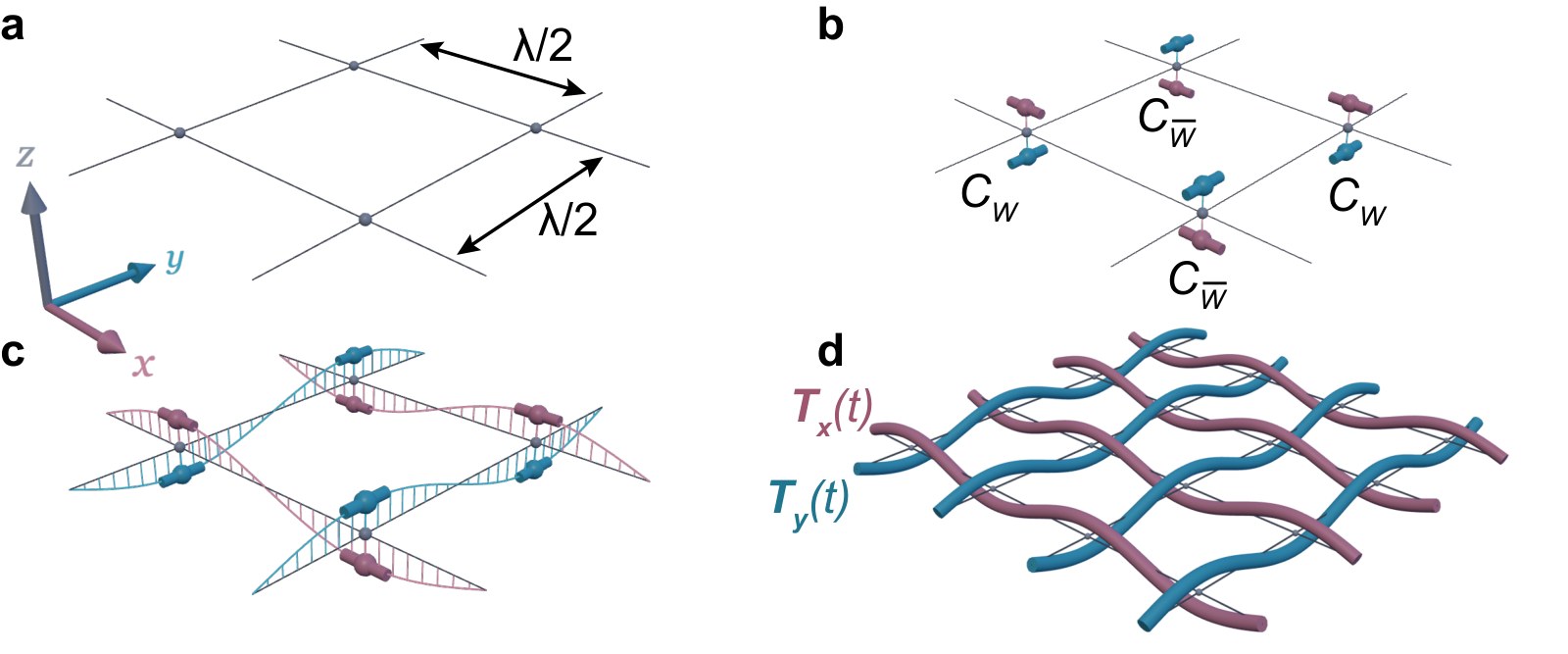
Crossings
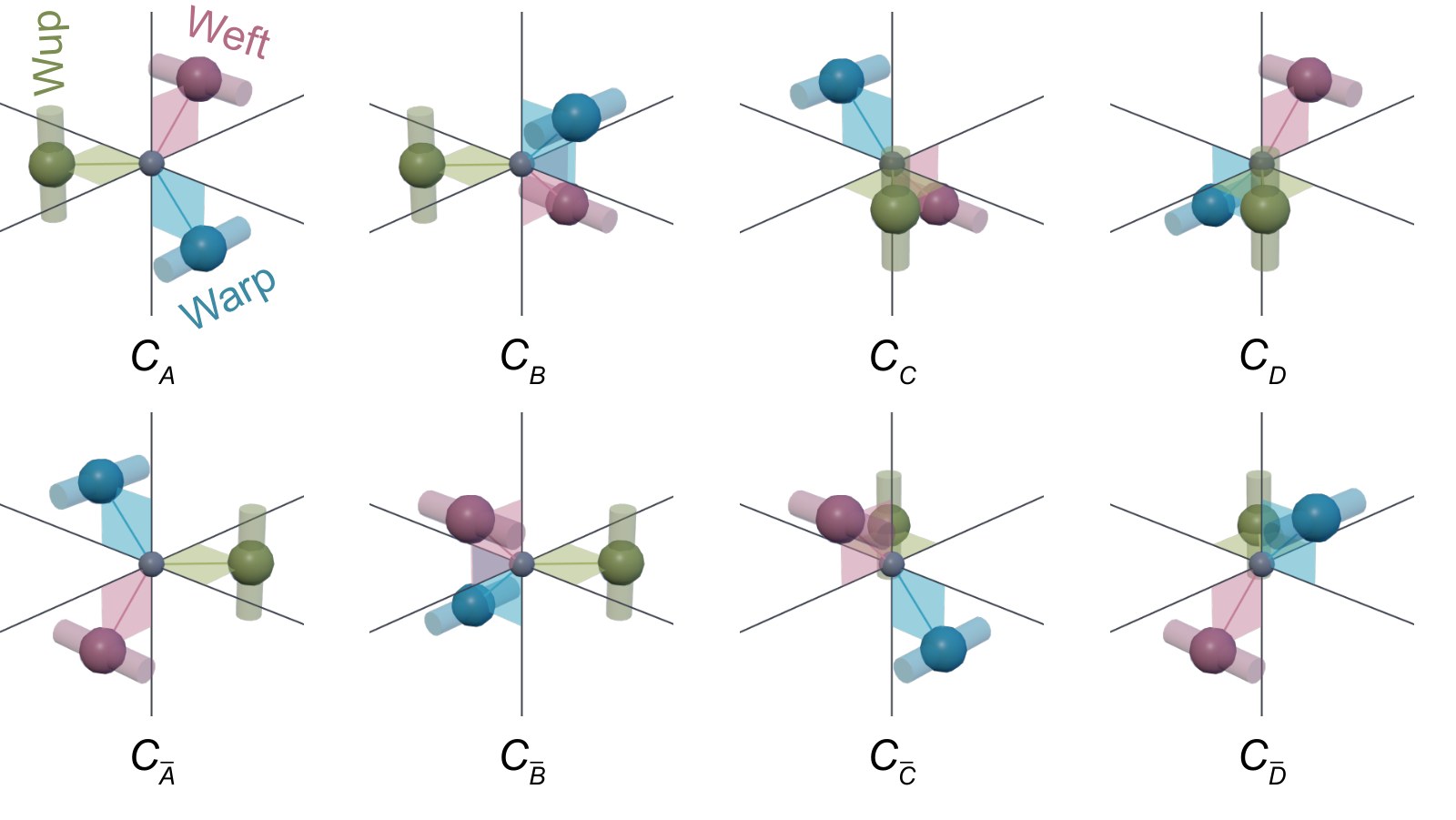
At each vertex, every yarn is offset by ±a in the two directions perpendicular to it. To keep the over-under order, the two yarns perpendicular to a given direction take equal and opposite offsets along it, so the offsets cancel in each direction. We collect them in a 3 × 3 crossing matrix. The cancellation leaves three independent signs, and so eight configurations in four pairs, each pair related by reversing every crossing. The fully alternating weave places opposite configurations at neighbouring vertices, in a 2 × 2 × 2 unit cell. Rotations by π about the coordinate axes map the four pairs onto each other, and a translation by half a wavelength exchanges the two members of a pair: the fully alternating volumetric plain weave has a single topology.
Yarn trajectories
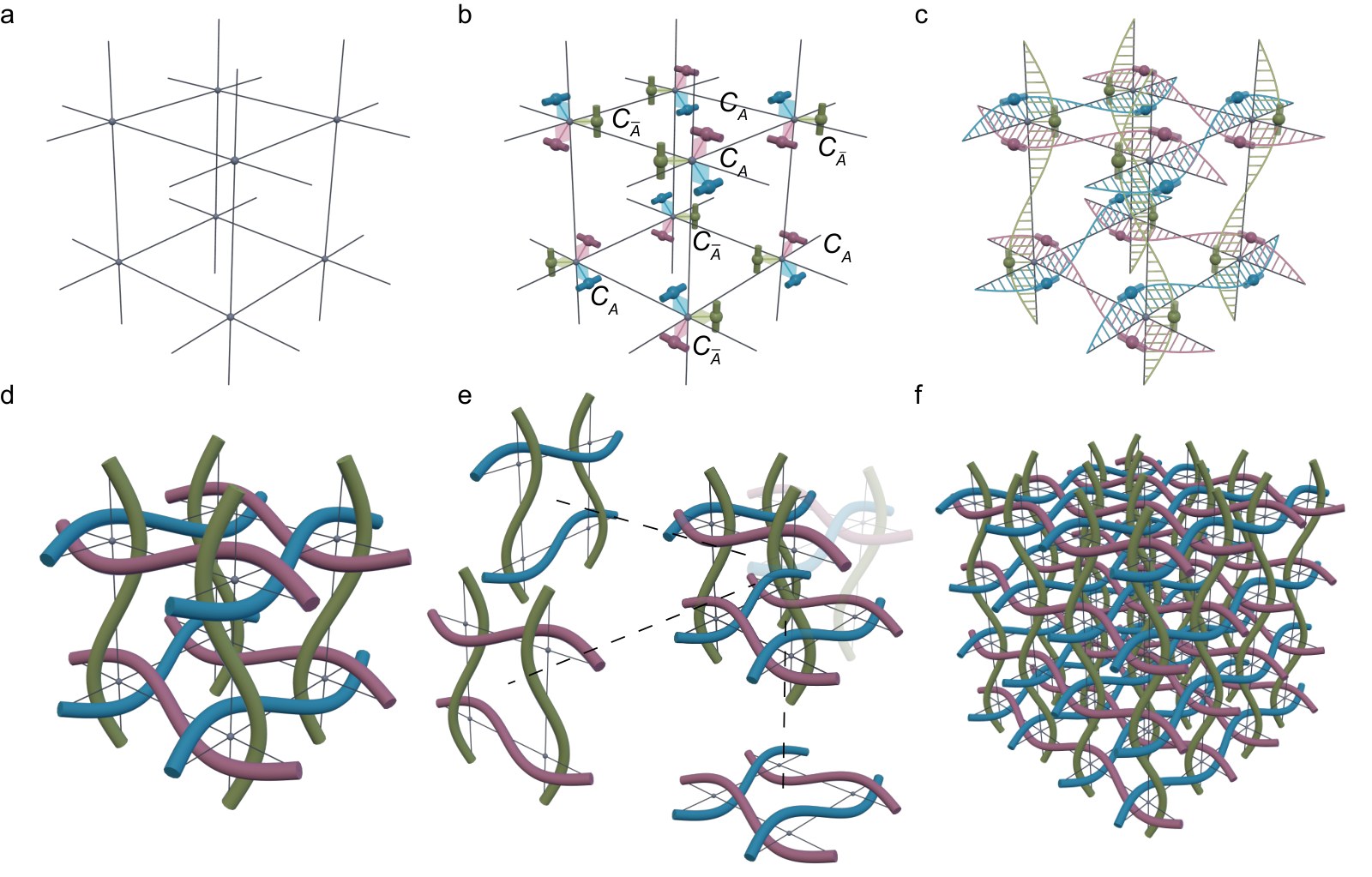
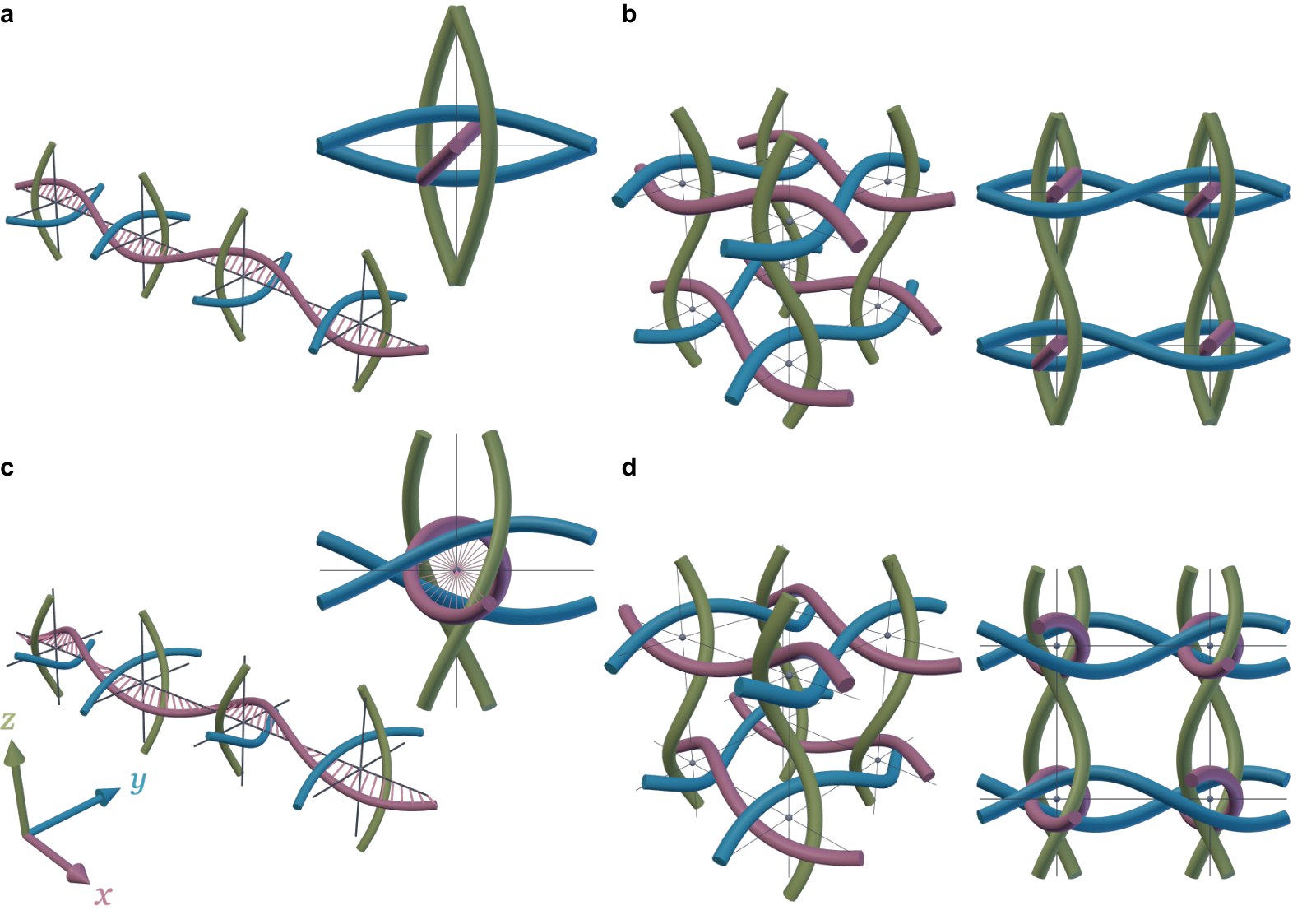
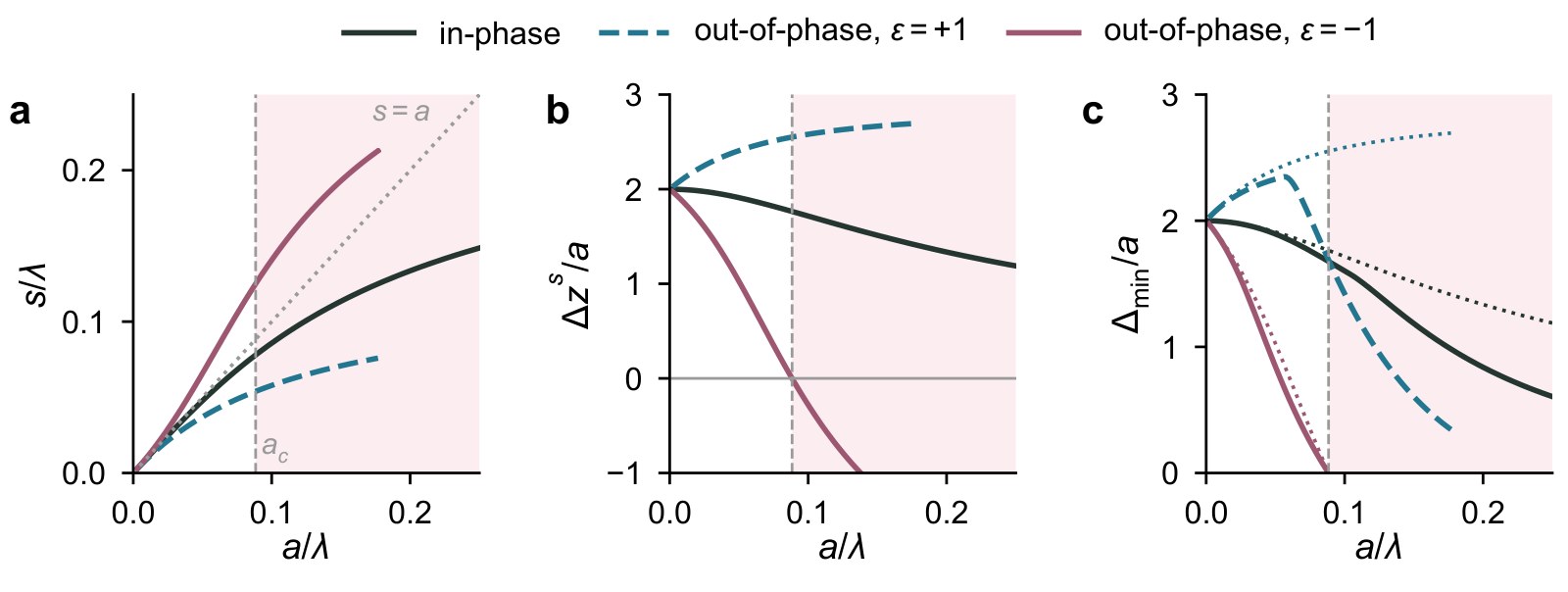
Each yarn follows its axis while its two transverse coordinates vary sinusoidally, with a wavelength λ of twice the vertex spacing, so that the offsets reverse at successive crossings. The crossing matrix at the origin fixes the phases of these oscillations. Two solutions follow. With in-phase oscillations, each yarn stays in a fixed oblique plane and is a planar zigzag. With a quarter-period lag between its two oscillations, and the amplitude increased to √2 a to keep the offsets at the crossings, each yarn is a circular helix. Both belong to a family of elliptical helices, in which the handedness of each yarn can be chosen independently: for the twelve yarns of the unit cell, the 4096 assignments reduce to 144 distinct weaves under the symmetries of the lattice, and to 76 when a weave and its mirror image are identified.
Intersections between vertices
The trajectories pass through the prescribed offsets at the vertices, but between vertices two centrelines could meet and change the topology. In-phase yarns never intersect, for any offset a. Helical yarns of equal handedness intersect at a critical offset of √2 λ/16, about 0.088 λ, beyond which the pair is inverted, and no assignment of handedness avoids these intersections. For yarns of finite radius R, the closest approach between two crossing yarns sets the admissible radius, 2R below the closest approach.
Fabrication
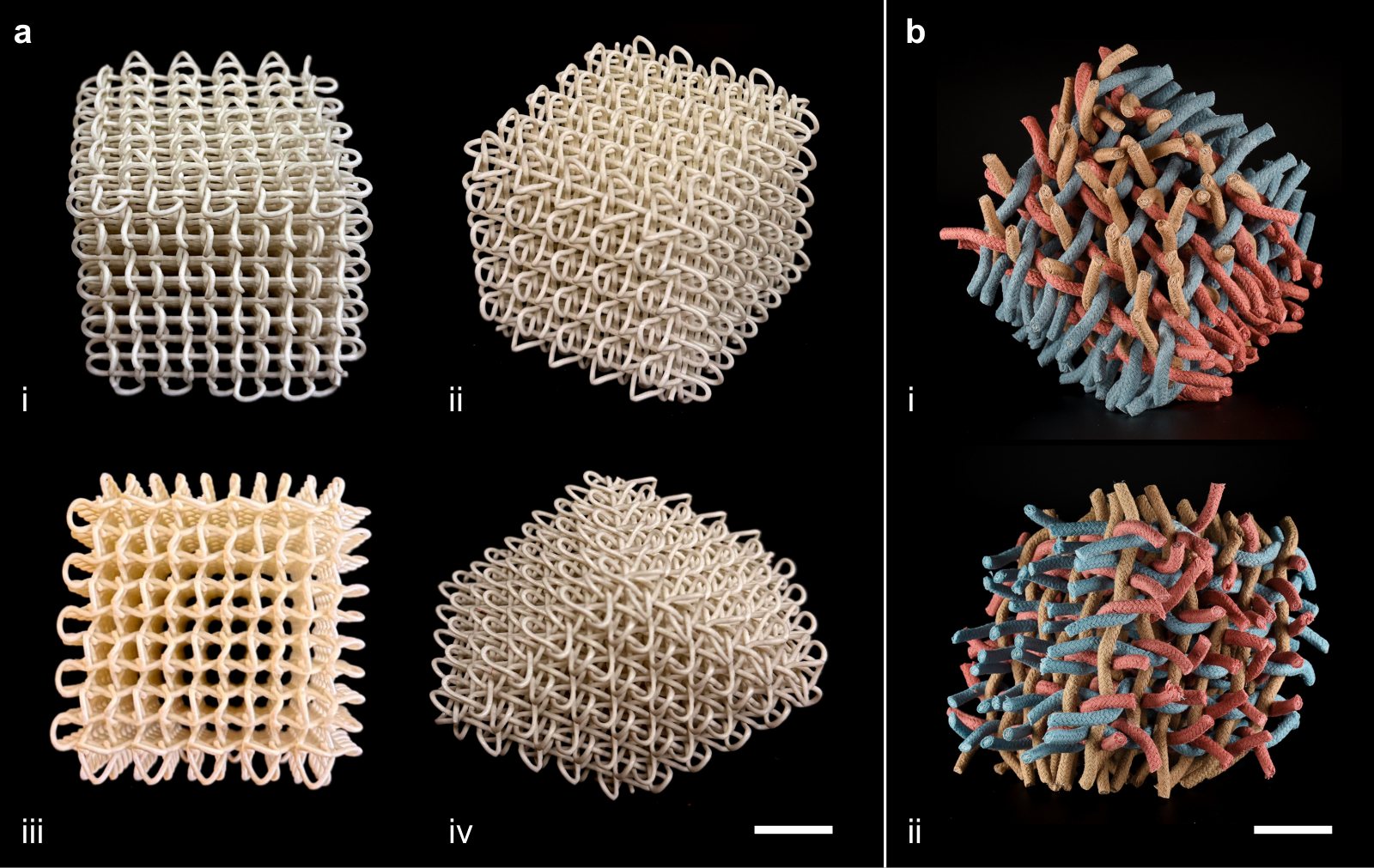
We printed an in-phase weave with configuration CA at the origin, λ = 10 mm, a = 0.7 mm and R = 0.5 mm: five unit cells along each direction, so that each yarn passes through ten crossings. At the boundaries each yarn was joined to the next, making each family a single continuous yarn. The model was printed on a Stratasys J35 in VeroUltraWhite, with a support material dissolved in water afterwards. It is stiff along the yarn axes and compliant between them, as plain weaves are, and it relaxes under gravity along a direction at 45° to the yarn axes.
We also assembled a weave by hand from cotton piping cord, 6 mm in diameter, in three colours. The cord was shaped into planar sinusoids in a 3D-printed mould, with a latex-paint conditioner holding the shape during assembly. The weft and warp were laid up in two-dimensional layers, and the layers were woven onto the 36 wup yarns one at a time, row by row. As it relaxed, the textile sheared within and out of the layer planes, giving the specimen rhomboidal faces.
The weave viewer
The weave viewer computes the yarn trajectories for a chosen crossing configuration, trajectory family and number of unit cells, in two or three dimensions, and saves them as images or as 3D models. The figures above were made with it, and the clip at the top of this page uses its geometry.
Next
Volumetric counterparts of twill and satin, in which a yarn passes several consecutive crossings on the same side, need trajectories of longer period with several harmonics; the crossing matrix and the intersection analysis carry over. The mechanics of the weaves come next: bending and sliding of the yarns between vertices, the dependence on λ, a and R, and the response to defects.
A collaboration with Samuel Poincloux (Aoyama Gakuin University) and Lauren Carelli Dreier (University of California, Santa Barbara).
Related publications
- Topology, geometry and fabrication of volumetric plain weaves. arXiv:2611.12091 (2026). PDF