Architected Intelligent Matter Laboratory
We explore programmable intelligent matter at the intersection of mechanics, geometry and fabrication. We aim to create materials whose physical properties and shape can be programmed on demand and in situ. Beyond programmability, we study materials that sense their own condition and tune their properties and shape to perform optimally. This intelligence is physical: it is embodied in the material's architecture and distributed across its elements. In the longer term, we work towards neuromorphic matter: materials that, like a nervous system, store and process information and adapt with use. We pursue this goal scientifically and through the practice of art.
Themes

Architecting nonlinear responses of metamaterials
We design the internal architecture of metamaterials to demonstrate responses that do not occur naturally. We focus on nonlinear mechanical behaviour, where large deformation, contact and instability govern the response. Further, we focus on stimulus-responsive characteristics, in which a uniform change in the surroundings produces designed, local or sequenced actions.

Frictional contact, sliding and entanglement
Structures whose responses are dominated by friction and entanglement are ubiquitous, from entangled polymers and DNA strands to woven baskets, textiles and composites. Their stiffness and dissipation come from friction and sliding between slender elements rather than from the material itself. We aim to understand their mechanics to engineer topological entanglement for functionality.

Mechanical computation and memory
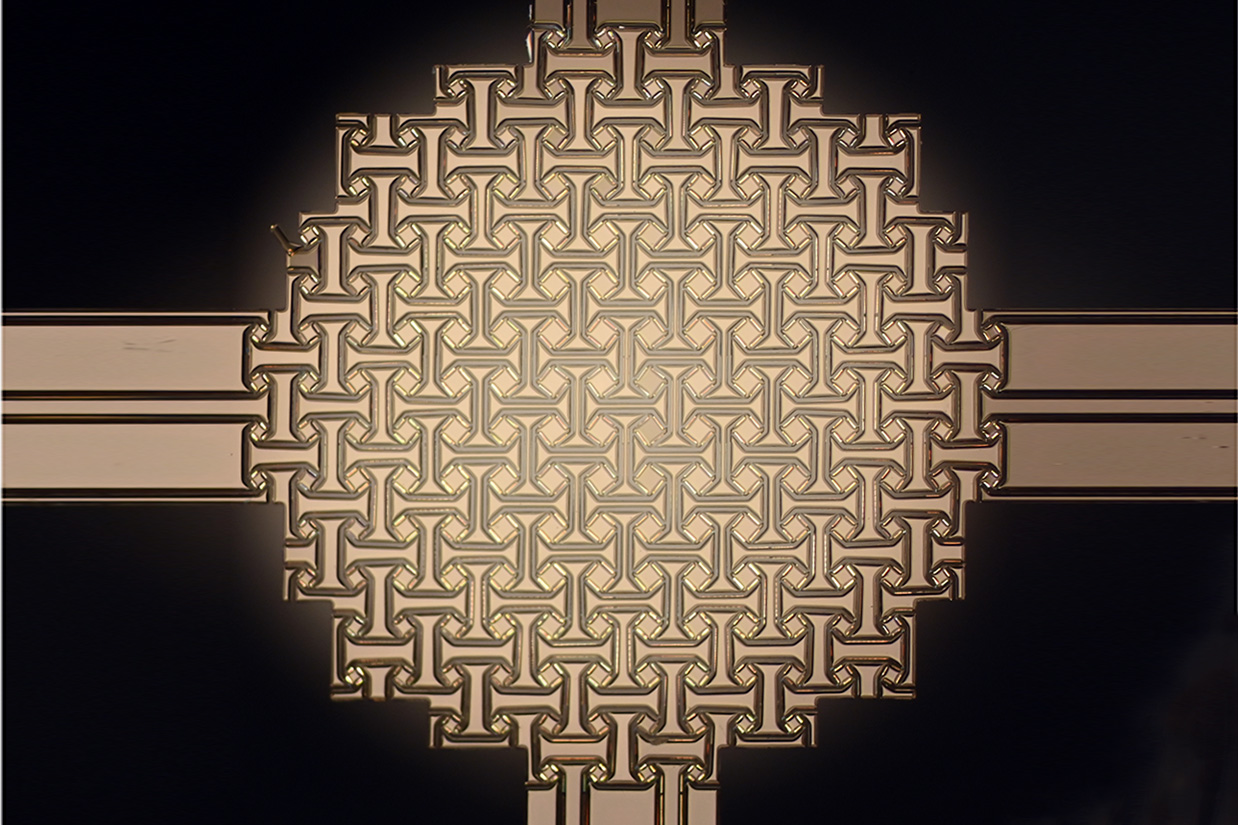
Snap-through and multistability give a structure more than one stable state, so that it can hold multiple configurations without external power. This notion may revolutionize material design by demonstrating architected materials whose physical behaviour can be programmed on-demand, in-situ and indefinitely. Further, with material feedback and rudimentary logic, we aim to create neuromorphic matter.
Programming shape through geometry
Natural and artificial systems constantly change shape, which we seek to understand through geometry and mechanics. Flat architected sheets are designed so that each region expands by a prescribed amount, and the mismatch between neighbouring cells forces the sheet into a chosen curved form. The geometric reasoning is scale invariant, and the same algorithm applies to micron-, centimetre- and metre-scale structures.